
BC Conservation Data Centre: Conservation Status Report
Tachycineta bicolor
Tree Swallow
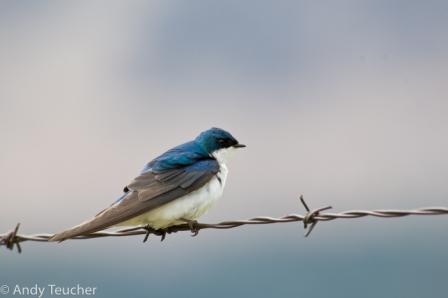
| Scientific Name: | Tachycineta bicolor |
|---|---|
| English Name: | Tree Swallow |
| Provincial Status Summary | |
| Status: | S5B |
| Date Status Assigned: | March 25, 2022 |
| Date Last Reviewed: | March 25, 2022 |
| Reasons: |
2022: Widespread breeder, but declines have been noted (Smith et al. 2020), some apparent expansion in range noted in the BC Breeding Bird Atlas (Ryder 2015). 2001:Widespread common breeder throughout BC. Population believed to be stable, no known threats. |
| Range | |
| Range Extent: | G = 200,000-2,500,000 square km |
| Range Extent Estimate (km2): | 944,735 square km |
| Range Extent Comments: | 944,735 square km based on confirmed and probable records in the BC Breeding Bird Atlas (Ryder 2015) and eBird (accessed Mach 2021). The species breeds throughout British Columbia including Haida Gwaii and Vancouver Island. Breeding appears to be sparser in the north (Ryder 2015). Requires more open country than Violet-green Swallow. Non-breeders have a widespread distribution throughout most of BC (Campbell et al. 1997). Atlas records (Ryder 2015) suggests that "there may have been recent local increases in its range in some parts of the province. For example, Campbell et al. (1997) noted an absence of records in the Northern Rocky Mountain Trench where the Atlas data shows a cluster of records in the vicinity of Williston Lake. Similarly, the Atlas records confirm breeding in several accessible areas in the western part of the Northern Boreal Mountains Ecoprovince where previous summer/breeding records were scarce". |
| Occurrences & Population | |
| Number of Occurrences: | Rank Factor not assessed |
| Comments: | Widespread breeder. |
| Number of Occurrences with Good Viability / Ecological Integrity: | Rank Factor not assessed |
| Number of Occurrences Appropriately Protected & Managed: | E = >40 |
| Comments: | Most parks with open areas near water that contain tree cavities containing breeding occurrences of Tree Swallows, (e.g.Manning Park; Vaseux Lake; Swan Lake; Reifel Island, Tatshenshini-Alsek, Stone Mountain, Akamina Kishenina). |
| Population Size: | H = >1,000,000 individuals |
| Comments: | PIF (2020) estimate is 1,800,000 (95% CL 1,100,000 to 2,800,000), Generally fairly common to very common/abundant breeder in its range (Campbell et al. 1997). |
| Threats (to population, occurrences, or area affected) | |
| Degree of Threat: | Rank Factor not assessed |
| Trend (in population, range, area occupied, and/or condition of occurrences) | |
| Short-Term Trend: | FH = Decline of <30% to increase of 25% |
| Comments: | Breeding Bird Survey analysis 2007-2017 suggests a decline -7.73% (95% CL -24.8 to +23) but note confidence intervals. Previously, short term trends from the Breeding Bird surveys (1968-1993) did not detect a net change in numbers (Campbell et al. 1997). |
| Long-Term Trend: | CG = Decline of <80% to Relatively Stable |
| Comments: | Breeding Bird Survey analysis from 1970-2019 suggests a decline -41.9% (95% CL -70.3 to +0.68) (Smith et al. 2020). North America wide, the areas of greatest decline, largely coincide with areas of greatest swallow density (literature reviewed in Winkler et al. 2020). |
| Other Factors | |
| Intrinsic Vulnerability: | Rank Factor not assessed |
| Environmental Specificity: | Rank Factor not assessed |
| Other Rank Considerations: | |
| Information Gaps | |
| Research Needs: | Hypothesis for the reasons for long term declines should be formulated and tested. |
| Inventory Needs: | Continued monitoring of BBS routes, Atlas projects and eBird data should be undertaken to document trends. Increased coverage of northern areas by the BBS would be desirable. |
| Stewardship | |
| Protection: | Wildlife Tree protections are important for this species. |
| Management: | Wildlife Trees should be maintained, and where they have been removed nest box programs can partially offset nest cavity loss (Winkler et al. 2002). |
| Version | |
| Author: | Fraser, D.F. |
| Date: | January 31, 2022 |
| References | |
|
Campbell, R.W., N.K. Dawe, I. McTaggart-Cowan, J.M. Cooper, G.W. Kaiser, M.C.E. McNall and G.E.J. Smith 1997. The Birds of British Columbia, Vol. 3, Passerines: Flycatchers through Vireos. UBC Press in cooperation with Environ. Can., Can. Wildl. Serv. and B.C. Minist. Environ., Lands and Parks, Wildl. Branch. 700pp.
|
|
|
Downes, C.M., and B.T. Collins. 2007. Canadian Bird Trends Web site Version 2.2. Canadian Wildlife Service, Environment Canada, Gatineau, Quebec, K1A 0H3.
|
|
Please visit the website Conservation Status Ranks for information on how the CDC determines conservation status ranks. For global conservation status reports and ranks, please visit the NatureServe website http://www.natureserve.org/.
Suggested Citation:
B.C. Conservation Data Centre. 2022. Conservation Status Report: Tachycineta bicolor. B.C. Minist. of Environment. Available: https://a100.gov.bc.ca/pub/eswp/ (accessed Oct 3, 2026).