
BC Conservation Data Centre: Conservation Status Report
Buteo jamaicensis
Red-tailed Hawk
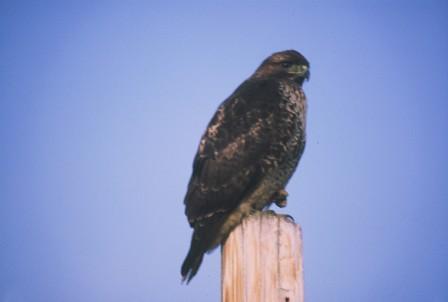
| Scientific Name: | Buteo jamaicensis |
|---|---|
| English Name: | Red-tailed Hawk |
| Provincial Status Summary | |
| Status: | S5 |
| Date Status Assigned: | June 30, 1998 |
| Date Last Reviewed: | March 05, 2015 |
| Reasons: | Widespread breeder and nonbreeder. Wintering populations may be increasing in Fraser Lowlands. |
| Range | |
| Range Extent: | H = >2,500,000 square km |
| Range Extent Comments: | Breeds throughout the province, including offshore islands, from sea level to 2,230m. Widespread nonbreeder (D) found in almost any open or semi-open habitat from sea level to above timberline (2,500m), (Campbell et al. 1990b). |
| Occurrences & Population | |
| Number of Occurrences: | DE = 81 to >300 |
| Comments: | Widespread breeder. Highest breeding density in the Fraser Lowlands. A study by Runyan (1987) calculated a mean density of 1 nest per 3.6 km sq. in Richmond. Widespread nonbreeder (D). Major wintering area is Fraser Lowlands (Campbell et al. 1990b). |
| Number of Occurrences with Good Viability / Ecological Integrity: | Rank Factor not assessed |
| Number of Occurrences Appropriately Protected & Managed: | BC = 1 - 12 |
| Comments: | Some protection offered by parks and protected areas (Somenos Flats, Boundary Bay Nature Wildlife Area, Goldstream Park, Cypress Park, Rocky Point, Otter Lake Provincial Park, Reifel Island Bird Sanctuary, Fraser River Ecological Reserve). |
| Population Size: | DE = 1,000 - 10,000 individuals |
| Comments: | Highest breeding density is in Fraser Lowlands. Breeding densities are lowest in northern areas as well as on the Queen Charlotte Islands, northern mainland coast, and Vancouver Island. Nonbreeder (BC?): Uncommon resident along the coast, including Vancouver Island and the Queen Charlotte Islands, and in the Okanagan, Shuswap and South Thompson regions of the Thompson-Okanagan Plateau. Uncommon summer visitant throughout the rest of the province. Casual in winter in interior north of latitude 51 degrees N. Fairly common to common migrant throughout province (Campbell et al. 1990b). |
| Threats (to population, occurrences, or area affected) | |
| Degree of Threat: | Rank Factor not assessed |
| Comments: | No major threats at this time. |
| Trend (in population, range, area occupied, and/or condition of occurrences) | |
| Short-Term Trend: | U = Unknown |
| Comments: | Christmas Bird Count data (1972-1987) indicate a steady increase in numbers of wintering birds from the Fraser River delta and Pitt Meadows areas (Campbell et al. 1990b). |
| Long-Term Trend: | Rank Factor not assessed |
| Other Factors | |
| Intrinsic Vulnerability: | Rank Factor not assessed |
| Environmental Specificity: | Rank Factor not assessed |
| Other Rank Considerations: | |
| Information Gaps | |
| Research Needs: | |
| Inventory Needs: | Inventory using standardized procedures (RIC 1997d, Raptors #11) to determine the range of the 3 subspecies found in BC. |
| Stewardship | |
| Protection: | |
| Management: | |
| Version | |
| Author: | Westereng, L.K. |
| Date: | March 10, 2000 |
| References | |
|
Campbell, R.W., N.K. Dawe, I. McTaggart-Cowan, et al. 1990b. The Birds of British Columbia Vol. 2: Nonpasserines: Diurnal Birds of Prey through Woodpeckers. Royal British Columbia Museum, Victoria, BC.
|
|
|
Resource Inventory Committee. 1997e. Standardized Inventory Methodologies for Components of British Columbia's Biodiversity: Raptors, version 1.1. Prepared for the Resour. Inventory Comm., B.C. Minist. Environ., Lands and Parks, Victoria, BC. 56pp.
|
|
|
Runyan, C.S. 1987. Location and density of nests of the Red-tailed Hawk, Buteo jamaicensis, in Richmond, British Columbia. Can. Field-Nat. 101:415-418.
|
|
Please visit the website Conservation Status Ranks for information on how the CDC determines conservation status ranks. For global conservation status reports and ranks, please visit the NatureServe website http://www.natureserve.org/.
Suggested Citation:
B.C. Conservation Data Centre. 2000. Conservation Status Report: Buteo jamaicensis. B.C. Minist. of Environment. Available: https://a100.gov.bc.ca/pub/eswp/ (accessed Oct 7, 2026).