
BC Conservation Data Centre: Conservation Status Report
Plethodon vehiculum
Western Red-backed Salamander
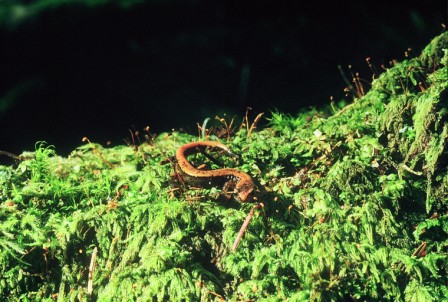
| Scientific Name: | Plethodon vehiculum |
|---|---|
| English Name: | Western Red-backed Salamander |
| English Name Synonyms: |
Western Redback Salamander
|
| Provincial Status Summary | |
| Status: | S4 |
| Date Status Assigned: | January 12, 1994 |
| Date Last Reviewed: | March 23, 2022 |
| Reasons: | The species seems to remain widespread and locally abundant; however, it is potentially vulnerable to a variety of threats, including climate change (K. Ovaska, pers. comm. 2010). |
| Range | |
| Range Extent: | F = 20,000-200,000 square km |
| Range Extent Estimate (km2): | 74,977 to 88,206 |
| Range Extent Comments: | Occurs throughout Vancouver Island, on the adjacent mainland, through the Fraser River valley to Hope, and up the Lillooet River to Pemberton (Matsuda et al. 2006). There is one record that is out of range from 2018 near Kelowna that was photographed and verified (https://www.inaturalist.org/observations/17948081). It was found in a garden centre, that in this case, grows most of their own plants, so although it is possible that the individual hitched a ride, it is not likely. We have calculated Range Extents that both include (88,206 km2) and exclude (74,977 km2) this record. In both cases the result fall within "F". |
| Area of Occupancy (km2): | FG = 126-2,500 |
| Area of Occupancy Estimate (km2): | 316 |
| Area of Occupancy Comments: | 1244 km2 was calculated via iNaturalist (accessed 23-February-2022), therefore this will be the minimum. |
| Occurrences & Population | |
| Number of Occurrences: | CD = 21 - 300 |
| Comments: | Represented by many and/or large occurrences throughout most of the range. |
| Number of Occurrences with Good Viability / Ecological Integrity: | Rank Factor not assessed |
| Comments: | Likely many occurrences have good viability. The old-growth forest in Goldstream Provincial Park, Vancouver Island provides excellent habitat and supports extraordinary high densities (Ovaska 2007) . |
| Number of Occurrences Appropriately Protected & Managed: | U = Unknown |
| Comments: | Found in several protected areas including Goldstream Provincial Park, Vancouver Island. |
| Population Size: | F = 10,000 - 100,000 individuals |
| Comments: | Total adult population size is unknown but likely exceeds 10,000. One of the most commonly encountered terrestrial salamanders throughout its range (Nussbaum et al. 1983). Goldstream Provincial Park exhibits extraordinary high densities with a surface density of 1.8 salamanders per meter square or 18,000 salamanders/ha. The population in Goldstream Provincial Park showed low year-to-year variability in population size and in the proportion of juveniles (Ovaska 2007). |
| Threats (to population, occurrences, or area affected) | |
| Degree of Threat: | CD = Medium - low |
| Comments: | Threats were assessed by experts in 2023. A range (low-medium) results from uncertainty of the impacts of climate change, which depends on the speed by which climate change and extreme events will proceed over the next 10 years and the buffering capacity of the salamanders' habitats, such as availability of refuges. The introduction and spread of the emerging fungal disease (BSal) is an unknown but a potential threat; it is yet to be reported from North America but which would have potentially devastating effects on salamander populations were it to arrive. |
| Trend (in population, range, area occupied, and/or condition of occurrences) | |
| Short-Term Trend: | U = Unknown |
| Comments: | Thought to be stable in the past. Current data are unavailable. Data from 1992-2007 in Goldstream Provincial Park show that this population is stable (Ovaska 2007), and populations at Rocky Point and Royal Roads also appear to be stable (K. Paige, pers. comm. 2007). |
| Long-Term Trend: | F = Decline of 10-30% |
| Comments: | Likely relatively stable in extent of occurrence, probably less than 25% decline in population size, area of occurrence, and number/condition of occurrences using forestry and the development of the lower mainland and Vancouver Island as areas of likely decline. |
| Other Factors | |
| Intrinsic Vulnerability: | B=Moderately vulnerable |
| Comments: | Terrestrial salamanders are sensitive to changes in moisture or temperature regimes on the forest floor. Mark-recapture data from Goldstream Provincial Park show that annual survival probability is high (60-70%) and that individuals can live at least 11-12 years. Maturation is estimated to occur at 3-4 years of age (Ovaska 2007). Females lay 8-20 eggs every second year (Matsuda et al. 2006). |
| Environmental Specificity: | D=Broad. Generalist or community with all key requirements common. |
| Comments: | This species is entirely terrestrial. It requires moisture to breathe through its skin and therefore does not do well in clear-cuts or open sunny areas. They are found in damp leaf litter and forest debris of mature and old-growth forests, under moss, rocks and decomposing logs. This salamander can also be found in younger reforested stands. This species feeds on a wide variety of terrestrial invertebrates (Matsuda et al. 2006). |
| Other Rank Considerations: | |
| Information Gaps | |
| Research Needs: | |
| Inventory Needs: | Monitoring of salamanders at Goldstream Provincial Park should continue as this site provides a baseline to investigate population trends in relation to climate change and other environmental changes in the future (Ovaska 2007). Monitoring sites at other locations on Vancouver Island (e.g. Royal Roads and Rocky Point) should continue for a minimum of 15 years to be effective. |
| Stewardship | |
| Protection: | |
| Management: | |
| Version | |
| Author: | Gelling, L. and L. Ramsay |
| Date: | February 26, 2022 |
| References | |
|
Matsuda, B.M., D.M. Green and P.T. Gregory. 2006. Royal BC Museum handbook amphibians and reptiles of British Columbia. Royal B.C. Mus., Victoria, BC. 266pp.
|
|
|
Nussbaum, R.A., E.D. Brodie Jr., and R.M. Storm. 1983. Amphibians and Reptiles of the Pacific Northwest. Univ. Press of Idaho. 332pp.
|
|
|
Ovaska, K. 2007. Monitoring a population of the Western Red-backed Salamander (Plethodon vehiculum) in Goldstream Provincial Park, Vancouver Island, BC. Report prepared for Goldstream Provincial Park, Victoria, BC. 9pp. + appendices.
|
|
Please visit the website Conservation Status Ranks for information on how the CDC determines conservation status ranks. For global conservation status reports and ranks, please visit the NatureServe website http://www.natureserve.org/.
Suggested Citation:
B.C. Conservation Data Centre. 2022. Conservation Status Report: Plethodon vehiculum. B.C. Minist. of Environment. Available: https://a100.gov.bc.ca/pub/eswp/ (accessed Jun 17, 2026).