
BC Conservation Data Centre: Conservation Status Report
Taricha granulosa
Rough-skinned Newt
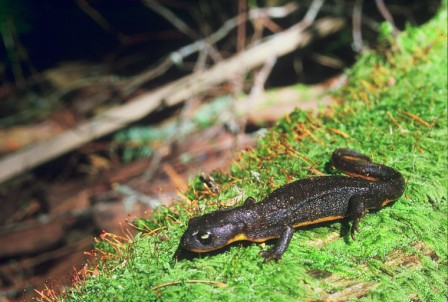
| Scientific Name: | Taricha granulosa |
|---|---|
| English Name: | Rough-skinned Newt |
| English Name Synonyms: |
Roughskin Newt
|
| Provincial Status Summary | |
| Status: | S4 |
| Date Status Assigned: | March 23, 2022 |
| Date Last Reviewed: | March 23, 2022 |
| Reasons: | Represented by many occurrences throughout most of the range which includes forests of Vancouver Island, the Gulf Islands and the entire mainland coast as far north as Echo Lake and Skeena River. Threats include habitat destruction, roads and pollution. |
| Range | |
| Range Extent: | G = 200,000-2,500,000 square km |
| Range Extent Estimate (km2): | 267,220 |
| Range Extent Comments: | Rough-skinned Newt occurs within forests of Vancouver Island, the Gulf Islands and the entire mainland coast as far north as Echo Lake and Skeena River, extending up major river valleys (Matsuda et al. 2006). |
| Area of Occupancy (km2): | FG = 126-2,500 |
| Area of Occupancy Estimate (km2): | 414 |
| Area of Occupancy Comments: | The estimate was made using mainly iNaturalist points therefore will be a minimum (Accessed 27-February-2022). |
| Occurrences & Population | |
| Number of Occurrences: | DE = 81 to >300 |
| Comments: | Represented by many occurrences throughout most of the range. |
| Number of Occurrences with Good Viability / Ecological Integrity: | Rank Factor not assessed |
| Number of Occurrences Appropriately Protected & Managed: | U = Unknown |
| Population Size: | U = Unknown |
| Comments: | Total adult population size is unknown. |
| Threats (to population, occurrences, or area affected) | |
| Degree of Threat: | C = Medium |
| Comments: |
An expert threats assessment occurred in 2022, resulting in a score of Low. 2016 assessment: they may be detrimentally impacted by deforestation of areas surrounding breeding sites (wetlands of a variety of types), though the degree of impact is difficult to quantify. In 2008, post-metamorphic newts in the province (1% in a sample size of 20 individuals) tested positive for Batrachochytrium dendrobatidis (Bd), an aquatic fungus that causes the disease chytridiomycosis in amphibians. Mortality, however, has not been recorded (Govindarajulu et al. 2013). |
| Trend (in population, range, area occupied, and/or condition of occurrences) | |
| Short-Term Trend: | U = Unknown |
| Comments: | Likely stable in extent of occurrence and probably stable to slightly declining in population size, area of occupancy, and number/condition of occurrences. |
| Long-Term Trend: | U = Unknown |
| Other Factors | |
| Intrinsic Vulnerability: | B=Moderately vulnerable |
| Comments: | Newts breed in early spring and neotenic individuals may start breeding in late fall. Eggs are laid singly attached to aquatic plants or submerged rocks and hatch in 20-26 days. Larvae transform in one or two seasons (Matsuda et al. 2006). |
| Environmental Specificity: | CD = Moderate to broad. |
| Comments: | This species can be common in mixed forests, usually near permanent ponds or swamps. It is found in older or mature forests with a good deal of deadfall/litter. Its diet consists of a variety of small invertebrates and tadpoles. Breeding sites include shalllow ponds, bogs, swamps and slow-moving streams. Larvae eat aquatic invertebrates (Matsuda et al. 2006). |
| Other Rank Considerations: | |
| Information Gaps | |
| Research Needs: | |
| Inventory Needs: | |
| Stewardship | |
| Protection: | |
| Management: | |
| Version | |
| Author: | Gelling, L. and L.Ramsay |
| Date: | February 28, 2022 |
| References | |
|
Govindarajulu et al. 2013. Batrachochytrium dendrobatidis surveillance in British Columbia 2008-2009, Canada. 5pp.
|
|
|
Matsuda, B.M., D.M. Green and P.T. Gregory. 2006. Royal BC Museum handbook amphibians and reptiles of British Columbia. Royal B.C. Mus., Victoria, BC. 266pp.
|
|
Please visit the website Conservation Status Ranks for information on how the CDC determines conservation status ranks. For global conservation status reports and ranks, please visit the NatureServe website http://www.natureserve.org/.
Suggested Citation:
B.C. Conservation Data Centre. 2022. Conservation Status Report: Taricha granulosa. B.C. Minist. of Environment. Available: https://a100.gov.bc.ca/pub/eswp/ (accessed Jun 3, 2026).