
BC Conservation Data Centre: Conservation Status Report
Aquila chrysaetos
Golden Eagle
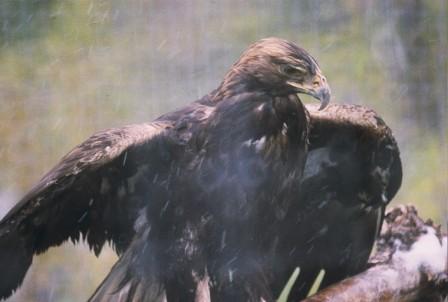
| Scientific Name: | Aquila chrysaetos |
|---|---|
| English Name: | Golden Eagle |
| Provincial Status Summary | |
| Status: | S4S5 |
| Date Status Assigned: | January 23, 2009 |
| Date Last Reviewed: | March 05, 2015 |
| Reasons: | Widespread breeder with range expanding; widespread nonbreeder. Moderate numbers that are stable or possibly increasing. Christmas Bird Counts indicate some increase. Protected from being killed, some habitat protected and no major threats at this time. |
| Range | |
| Range Extent: | G = 200,000-2,500,000 square km |
| Range Extent Comments: | Breeds on southeastern Vancouver Island, the Fraser Lowlands, and throughout most of the interior east of the Coast Ranges. Breeding records are lacking from the central part of the province where nesting habitat is marginal and food supplies are limited. Nonbreeders are widely distributed in the interior of BC east of the Coast Ranges, throughout the Fraser Lowlands, and along the east coast of Vancouver Island. Very few records for other coastal areas and none for Queen Charlotte Islands. Sea level to 3,200m (Campbell et al. 1990b). |
| Area of Occupancy (km2): | U = Unknown |
| Occurrences & Population | |
| Number of Occurrences: | DE = 81 to >300 |
| Comments: | Breeds throughout most of the province not including the Queen Charlotte Islands. |
| Number of Occurrences with Good Viability / Ecological Integrity: | Rank Factor not assessed |
| Number of Occurrences Appropriately Protected & Managed: | E = >40 |
| Comments: | Some protection offered in Kootenay National Park, Strathcona Park, Vaseux Wildlife Area, Vaseux Lake Migratory Bird Sanctuary, etc. |
| Population Size: | D = 1,000 - 2,500 individuals |
| Comments: | Breeding numbers unknown. Rare to uncommon resident in mountainous and hilly country across southern BC. Uncommon migrant and summer visitant in interior north of latitude 52 degrees N. Very rare in winter in the Peace Lowlands; casual elsewhere in the north (Campbell et al. 1990b). |
| Threats (to population, occurrences, or area affected) | |
| Degree of Threat: | Slightly threatened |
| Comments: | Locally threatened only--by disturbance, shooting, and loss of nest trees. Overall threat lessened by tolerance to some habitat modifications by humans. However, has shown a vulnerablitity to pesticides and other environmental contaminants elsewhere in its range. |
| Trend (in population, range, area occupied, and/or condition of occurrences) | |
| Short-Term Trend: | GH = Relatively Stable to increase of <25% |
| Comments: |
Establishment (as a breeding bird) and range expansion on Vancouver Island (from 1940's when it was considered casual by Munro and Cowan 1947) appears to correlate with the introduction of Eastern Cottontail. With large areas of coastal BC now opened through clearcut logging, there may be further expansion along the mainland coast. Populations in the interior of BC appear stable (Campbell et al. 1990b). Note that from 1940s-1960s over 20,000 Golden Eagles were killed in the southwestern USA (Spofford 1969) as part of an eradication program because of the damage the birds were believed to have caused to domestic livestock (Beebe 1974). Numbers in eastern North America now appear to be increasing and estimates range from 50,000-100,000 birds (Campbell et al. 1990b). Christmas Bird Count data indicate an increase while there is a non-significant decrease via breeding bird surveys, however this is based on very few routes. |
| Long-Term Trend: | FH = Decline of <30% to increase of 25% |
| Other Factors | |
| Intrinsic Vulnerability: | Rank Factor not assessed |
| Environmental Specificity: | C=Moderate. Generalist or community with some key requirements scarce. |
| Other Rank Considerations: | |
| Information Gaps | |
| Research Needs: | |
| Inventory Needs: | |
| Stewardship | |
| Protection: | Laws preventing the destruction of this species are in place and need to be enforced. |
| Management: | |
| Version | |
| Author: | Westereng, L.K. |
| Date: | March 10, 2000 |
| References | |
|
Beebe, F.L. 1974. Field studies of the Falconiformes of British Columbia: vultures, hawks, falcons, eagles. B.C. Prov. Mus. Occas. Pap. No. 17, Victoria, 163pp.
|
|
|
Campbell, R.W., N.K. Dawe, I. McTaggart-Cowan, et al. 1990b. The Birds of British Columbia Vol. 2: Nonpasserines: Diurnal Birds of Prey through Woodpeckers. Royal British Columbia Museum, Victoria, BC.
|
|
|
Munro, J.A., and I.McT. Cowan. 1947. A review of the bird fauna of British Columbia. B.C. Prov. Mus. Spec. Publ. No. 2, Victoria.
|
|
|
Spofford, W. 1969. Problems of the Golden Eagle in North America. Pages 345-347 in J. Hickery (ed.). Peregrine Falcon populations; their biology and decline. Univ. of Wisconsin Press, Madison.
|
|
Please visit the website Conservation Status Ranks for information on how the CDC determines conservation status ranks. For global conservation status reports and ranks, please visit the NatureServe website http://www.natureserve.org/.
Suggested Citation:
B.C. Conservation Data Centre. 2000. Conservation Status Report: Aquila chrysaetos. B.C. Minist. of Environment. Available: https://a100.gov.bc.ca/pub/eswp/ (accessed Jun 4, 2026).