
BC Conservation Data Centre: Conservation Status Report
Thamnophis sirtalis
Common Gartersnake
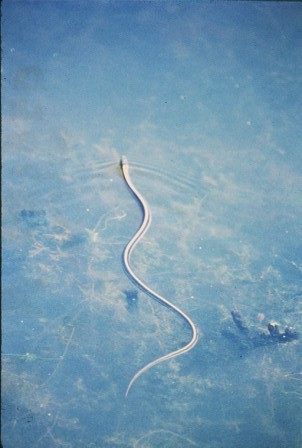
| Scientific Name: | Thamnophis sirtalis |
|---|---|
| English Name: | Common Gartersnake |
| English Name Synonyms: |
Common Garter Snake
|
| Provincial Status Summary | |
| Status: | S5 |
| Date Status Assigned: | |
| Date Last Reviewed: | March 28, 2025 |
| Reasons: | This species is found commonly throughout most of the province and has no major threats identified. |
| Range | |
| Range Extent: | G = 200,000-2,500,000 square km |
| Range Extent Estimate (km2): | 636,142 |
| Range Extent Comments: | This species is found throughout much of the southern 2/3 of the province. It ranges is as far north as Hazelton and the Nass River in the west and Fort St John in the east. It is found throughout Vancouver Island, but not Haida Gwaii (Matsuda et al. 2006, GBIF; accessed 26 January 2025). |
| Area of Occupancy (km2): | U = Unknown |
| Occurrences & Population | |
| Number of Occurrences: | E = > 300 |
| Comments: | There are nearly 3500 observations on GBIF (accessed 26 January 2025). |
| Number of Occurrences with Good Viability / Ecological Integrity: | U = Unknown |
| Number of Occurrences Appropriately Protected & Managed: | U = Unknown |
| Population Size: | U = Unknown |
| Comments: | Total adult population size is unknown. |
| Threats (to population, occurrences, or area affected) | |
| Degree of Threat: | D = Low |
| Comments: |
Road mortality and climate change (e.g., shifting habitats, and droughts and temperature extremes that affect the prey base) were identified as the largest threats for this species. The species' range overlaps with the geographic area of the province that has extensive land use for agriculture and forestry, a variety of non-native vertebrate predators in aquatic habitats, and experiences relatively high development pressure. However, it is a generalist that occurs in and exploits a variety of habitat types and elevations and is adaptable to habitat change. Pollutants may affect the species (e.g., bioaccumulate toxins via their prey), but the extent of impacts are unknown. 4.1 Roads and Railways: Impact score is Low. The exposure of this species to roads, and thus potential for roadkill, is variable across their broad range (e.g., high in the Lower Mainland vs. low in parts of inland BC). The wide distribution dilutes (range extent) this threat. Individuals cover large distances over the active season and are likely to encounter roads. Average distance between summer and winter range for this species in eastern BC was 1.5 km, with a maximum of 2.7 km with cumulative distance moved over active season estimated to be between 3.5 and 15 km (McAllister 2018). Colubrid snakes move hundreds of meters to kilometers away from dens sites (Macartney et al. 1988). The species is commonly observed alive and dead on roads (approximately 14% of the 3,082 of the observations for this species in iNaturalist for BC were of snakes on roads; Wind, pers. obs.), but no studies have determined road mortality rates for the species. Fewer T. sirtalis captured at sites with higher road densities in ON (Gigeroff 2022). Roads alter movement patterns for this species and make it more difficult for males to find mates (Shine et al. 2004). They may be attracted to edge habitat near roads (Wagner et al. 2021), but not in all landscapes (Patrick and Gibbs 2009). The species will use underpasses when available (Dillon et al. 2020; Boyle et al. 2021), but underpasses are not effective where road crossing locations occur over a broad area (i.e., are not localized; Wagner et al. 2021). Negative effects are likely greatest where roads occur near critical habitat, such as overwintering dens. Blasting of a rocky outcrop in Idaho for road construction, the latter of which was used by T. elegans for overwintering, resulted in direct mortalities and no further observations of the species in the area (Andrews et al. 2006). Garter snake use of rocky outcrops along roadways in BC as hibernaculum (Van Damme 2009), however it is unlikely that entire populations are lost. 9.3 Agricultural and Forestry Effluents: Impact Score is Unknown. Herbicides and pesticides. Scope: The range of this species overlaps with extensive agricultural and forestry development across BC, however the large range likely dilutes effects. Numerous chemicals are associated with these industries (e.g., the herbicide glyphosate; Govindarajulu 2008). A review found only one study with this species and herbicides used in forestry (from Ontario) - no obvious negative effects from herbicide treatment were documented (possibly positive effects; Lautenschlager and Sullivan 2002). Reduction in amphibian populations, which are their primary prey base may negatively affect this gartersnake?s populations. Snakes bioaccumulate pollutants such as pesticides and PCBs (Quoc Hoang et al. 2021) but the impact on populations of this species in BC are not known. Under 11. Climate Change four threats each scored low. They are: 11.1 Habitat Shifts and Alterations: Throughout this species? range, |
| Trend (in population, range, area occupied, and/or condition of occurrences) | |
| Short-Term Trend: | U = Unknown |
| Comments: |
Extent of occurrence and area of occupancy are likely relatively stable or declining at a low rate. The population size is unknown, as is the trend. There are some anecdotal reports of declines in population in long term monitoring sites in the Chilcotin and Okanagan Falls (P. Gregory, pers. comm. 2008). |
| Long-Term Trend: | U = Unknown |
| Other Factors | |
| Intrinsic Vulnerability: | C=Not intrinsically vulnerable |
| Environmental Specificity: | C=Moderate. Generalist or community with some key requirements scarce. |
| Other Rank Considerations: | |
| Information Gaps | |
| Research Needs: | |
| Inventory Needs: | |
| Stewardship | |
| Protection: | |
| Management: | |
| Version | |
| Author: | Ramsay, L. (2025), Westereng, L. (2011) |
| Date: | January 26, 2025 |
| References | |
|
Andrews, K.M., J.W. Gibbons, and D.M. Jochimsen. 2006. Literature Synthesis of the Effects of Roads and Vehicles on Amphibians and Reptiles. Federal Highway Administration (FHWA), U.S. Department of Transportation, Report No. FHWA-HEP-08-005. Washington, D.C. 151 pp.
|
|
|
Boyle, S.P., M.G. Keevil, J.D. Litzgus, D.T., and D. Lesbarrères. 2021. Road-effect mitigation promotes connectivity and reduces mortality at the population-level. Biological Conservation. 261(September 2021):1-10.
|
|
|
Bunnell, F.L., L.L. Kremsater, and R.W. Wells. 2011. Global weirding in British Columbia: Climate change and the habitat of terrestrial vertebrates. BC Journal of Ecosystems and Management 12(2): 21?38.
|
|
|
Combrink, L.L., A.M. Bronikowski, D.A.W. Miller, and A.M. Sparkman. 2022. Current and time-lagged effects of climate on innate immunity in two sympatric snake species. Ecology and Evolution 11(7):3239-3250.
|
|
|
Dillon, R.M., S.P. Boyle, Litzgus, J.D., and D. Lesbarrères. 2020. Build it and some will use it: a test of road ecopassages for eastern gartersnakes. Journal of Herpetology 54(1):19-23.
|
|
|
GBIF.org. 2025l. GBIF. Occurrence download for Thamnophis sirtalis. Accessed 26 January 2025.
|
|
|
Gigeroff, A. 2022. Do roads affect the abundance of garter snakes (Thamnophis sirtalis) and redbelly snakes (Storeria occipitomaculata)? Masters Thesis. University of Ottawa, Ottawa, ON. 54 pp.
|
|
|
Govindarajulu, P.P. 2008. Literature review of impacts of glyphosate herbicide on amphibians: What risks can the silvicultural use of this herbicide pose for amphibians in B.C.?. B.C. Ministry of Environment, Victoria, BC. Wildlife Report No. R-28.
|
|
|
Lautenschlager, R.A., and T.P. Sullivan. 2002. Effects of herbicide treatments on biotic components in regenerating northern forests. The Forestry Chronicle 78(5):695-731.
|
|
|
Macartney, J.M., P.T. Gregory, and K.W. Larsen. 1988a. A tabular survey of data on movements and home ranges of snakes. Journal of Herpetology 22(1):61-73.
|
|
|
Markle, C.E., P.A. Moore, and J.M. Waddington. 2020. Temporal variability of overwintering conditions for a species-at-risk snake: Implications for climate change and habitat management. Global Ecology and Conservation 22(June 2020):1-9.
|
|
|
Matsuda, B.M., D.M. Green and P.T. Gregory. 2006. Royal BC Museum handbook amphibians and reptiles of British Columbia. Royal B.C. Mus., Victoria, BC. 266pp.
|
|
|
McAllister, J. 2018. Natural history of common gartersnakes (Thamnophis sirtalis) in east-central British Columbia. MSc thesis. University of Victoria. Victoia, BC. 130 pp.
|
|
|
Patrick, D.A., and J.P. Gibbs. 2009a. Snake occurrences in grassland associated with road versus forest edges. Journal of Herpetology 43(4), 716-720.
|
|
|
Quoc Hoang, A., M. Binh Tu, S. Takahashi, T. Kunisue, and S. Tanabe. 2021. Snakes as biomonitors of environmental pollution: A review on organic contaminants. Science of The Total Environment 770(May 2021).
|
|
|
Shine, R., and R.T Mason. 2004. Patterns of mortality in a cold-climate population of garter snakes (Thamnophis sirtalis parietalis). Biological Conservation 120(2):201-210.
|
|
|
Van Damme, L.M. 2009. Melanstic Wandering Gartersnake (Thamnophis elegans vagrans) and discovery of a hibernaculum in the Creston Valley, British Columbia. Wildlife Afield. Dec. 2009:164-165.
|
|
|
Wagner, R.B., C.R. Brune, and V.D. Popescu. 2021. Snakes on a lane: Road type and edge habitat predict hotspots of snake road mortality. Journal for Nature Conservation. Volume 61, June 2021, 125978.
|
|
|
White, R.H., S. Anderson, J.F. Booth, G. Braich, C. Draeger, C. Fei, C.D. G. Harley, S.B. Henderson, M. Jakob, C-A. Lau, L.M.Admasu, V. Narinesingh, C. Rodell, E. Roocroft, K.R. Weinberger and G. West. 2023. The Unprecedented Pacific Northwest Heatwave of June 2021. Nature Communications 14(727):1-20.
|
|
Please visit the website Conservation Status Ranks for information on how the CDC determines conservation status ranks. For global conservation status reports and ranks, please visit the NatureServe website http://www.natureserve.org/.
Suggested Citation:
B.C. Conservation Data Centre. 2025. Conservation Status Report: Thamnophis sirtalis. B.C. Minist. of Environment. Available: https://a100.gov.bc.ca/pub/eswp/ (accessed Apr 17, 2026).