
BC Conservation Data Centre: Conservation Status Report
Erethizon dorsatum
North American Porcupine
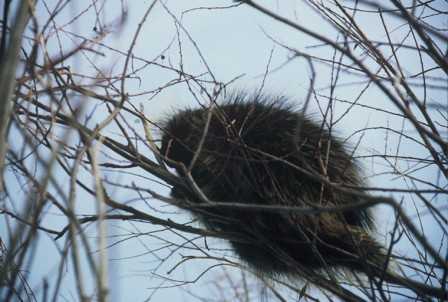
| Scientific Name: | Erethizon dorsatum |
|---|---|
| English Name: | North American Porcupine |
| Provincial Status Summary | |
| Status: | S4S5 |
| Date Status Assigned: | March 15, 2023 |
| Date Last Reviewed: | March 15, 2023 |
| Reasons: | This species is wide-ranging within BC and occurs within a variety of habitats. Threats are considered Low-medium; the most significant threat is impact from climate change (i.e. variability in winter precipitation). There is evidence of population decline in both the short and long term. |
| Range | |
| Range Extent: | G = 200,000-2,500,000 square km |
| Range Extent Estimate (km2): | 903,245 |
| Range Extent Comments: | A thorough review of current data allowed the rank to be refined. This species is wide ranging in BC; however, trends have shown an overall decline. |
| Area of Occupancy (km2): | I = >12,500 |
| Occurrences & Population | |
| Number of Occurrences: | E = > 300 |
| Comments: | NatureServe separation distances for Porcupine Element Occurrences is 10 km for both suitable and unsuitable habitat. Because this species occurs throughout most of the province, in a wide variety of habitats, the number of element occurrences most certainly exceeds 300. |
| Number of Occurrences with Good Viability / Ecological Integrity: | Rank Factor not assessed |
| Number of Occurrences Appropriately Protected & Managed: | Rank Factor not assessed |
| Population Size: | U = Unknown |
| Comments: | There is an absence of rigorous survey data that would allow reasonable extrapolation of data to determine a metric for current population size, thus, it is not possible to speculate on population size using available data. Any estimate of current population size would be further confounded by the species? evident cyclical 11-year population pattern that is influenced by solar/weather conditions: ?Klvana et al. (2004) suggested solar cycles were linked to the abundance of porcupines. In that study, observed fluctuations in porcupine abundance and solar irradiance were closely associated at periodicities of 11 and 22 years. Spring temperatures, winter precipitation and snowfall in turn followed the solar cycles, resulting in fluctuations of porcupine numbers.? (Butcher et al. 2015). Estimating population size is further confounded as evidence from Wasstrom et al. (2020) suggest the population is no longer behaving in a cyclical nature and is simply ?crashing? without the predicted cyclical recovery between restriction events. (Note: the cyclical population abundance levels were further supported by Mabille et al. (2010); they also demonstrated a cyclic population cycle (over a much longer 132-year period) with extreme fluctuations in population size. Mabille (2020) and Sweitzer et al. (2007) also documented extreme variation (i.e., up to 97% declines) in two independent short-duration (i.e., five-year) studies. |
| Threats (to population, occurrences, or area affected) | |
| Degree of Threat: | CD = Medium - low |
| Comments: |
A formal threats assessment has not been completed; however, given that North American Porcupine is a generalist, and the species occupies a diverse suite of habitat types, a range score of ?Low ? Medium? is likely appropriate to reflect uncertainty (J. Hobbs, pers. comm. 2023). Stressors have been most precisely described in Mabille et al. 2010 which include local variations in winter precipitation (e.g. causing increased predation rate and starvation), mortality sources (e.g. falls from height and vehicle-encounters), and susceptibility to pneumonia in wet environments given the species? small lung capacity (Hooven 1971, as cited in Appel et al. 2020). A reasonable summary of threats suggest climate influence (specifically increased variability in winter precipitation as a result of climate change: IUCN Threat 11) is widely recognized in the literature as the driving, or predominant threat, to North American Porcupine population dynamics. Winter precipitation (type and amount) affects local predator?prey interactions, and purportedly has the most dramatic impacts on porcupine winter survival rates (Mabille et al. 2010). Characterizing, attributing, and predicting threats brought about by climate change (i.e., variability in winter precipitation) will remain enigmatic. This is further confounded by the challenge faced when attempting to model habitat suitability under current conditions. Gyug (2008) summarizes the issue aptly, stating that ?the habitat needs of the porcupine are so general (herbaceous and other vegetation in the summer near to resting trees, and intermediate-sized coniferous trees for feeding in the winter, near to suitable denning sites (trees/logs or rocks)), that any model developed will necessarily be very general, and applicable to many types of stands.? This generalist ecological strategy employed by porcupines challenges suitability modeling, and thus challenges quantitation of future threats and trends for the species. In addition, given the large distribution of the species, point-source threats (e.g., falling from height, road mortality and predation) are unlikely to be consistently expressed, or to be consistently detrimental, across the range of the species. Instead, consideration to threats should arguably be solely focused on widely occurring phenomena (i.e., climate change) when considering threats (and trends) to North American Porcupine in BC. |
| Trend (in population, range, area occupied, and/or condition of occurrences) | |
| Short-Term Trend: | BE = Decline of 30-90% |
| Comments: | Wasstrom (2020) recognized that empirical research on North American Porcupine in BC is very limited with a suggested decline of 34-86% reported across all nine Ministry of Environment Regions in BC. There is a compelling argument of persistent, short-term, and long-term and (in some studies) dramatic population declines (Cottel, C. 2005, Butcher et al. 2015, Wasstrom et al. 2020, Appel et al. 2017, Mallie, K. 2008 and Mabille et al. 2010). The most informative metric presented, by Wasstrom et al. (2020), was road mortality data from the BC Wildlife Accident Reporting System (data compiled by the BC Ministry of Transportation and Infrastructure). Although a slight declining trend is arguably evident (since a 1992 ?peak? in road mortality) the trend is less evident over a longer time period; this is likely an artifact of citizen engagement increasing and masking trends in actual abundance. |
| Long-Term Trend: | DE = Decline of 30-70% |
| Comments: | C. Appel (and others) (2020) focused on a population of North American Porcupine in the Pacific Northwest (including Washington, Oregon and California). To this end the authors compiled 1,905 occurrence records of Porcupines between 1908 to 2018. In contrast to earlier conclusions the authors in this paper determined that the cause of widespread evident population declines does not appear to be (entirely) attributable to climate (as Porcupines inhabit a range of bioclimatic conditions across their range). Rather, it was suggested that declines may best be attributed ?to the spatial arrangement and scale of [anthropogenic] land-use change?, with legacy from historical (and, in some areas, ongoing persecution efforts, and widespread recovery in at least some populations of predator populations (including Cougar (Sweitzer et al. 2007), Coyote and Fisher). Appel et al. (2020) concluded that it is likely a combination of these stressors that have contributed to localized declines, and demographic characteristics of this long-lived slow-to-reproduce species. These stressors, combined, best explain the inability of Porcupine populations to recover (following declines) and to recolonize areas of former habitat following localized extirpations. |
| Other Factors | |
| Intrinsic Vulnerability: | A=Highly vulnerable |
| Comments: | This assignation is advised as the North American Porcupine is a long-lived (18 years) species that reproduces only annually, with typically only one young per reproductive event, and limited dispersal capabilities that may be hampered by lethal interactions with vehicles. |
| Environmental Specificity: | D=Broad. Generalist or community with all key requirements common. |
| Comments: |
From Efauna (Klinkenberg ND, accessed March 15, 2023): "Porcupines are dependent upon the availability of trees for food, and suitable denning sites and are primarily associated with forested areas from sea level to the sub-alpine, where dens are built under fallen trees, brush piles or stumps,in rock crevices and caves, and in burrows of other animals (Nagrosen 2005). However, in Washington State, they are found in ?unforested areas along riparian corridors with trees or large shrub growth, including lush sagebrush? (Lester 1997)." Gyug (2008) recognized that Structural Stage (with highest suitability habitat found in Structural Stage Four (SS4) forests (i.e., Pole Sapling)) is the primary factor affecting winter food availability, and may be the dominant factor affecting overall porcupine distribution and suitability. SS4 forests are described as forested areas with trees >10 m tall (typically densely stocked) with overtopped shrub and herb layers. In general, younger stands are vigorous (usually >10?15 years old) but older stagnated stands (up to 100 years old) are also included (albeit these older stagnated stands have little anticipated value to North American Porcupine). SS4 stands often occur by age 30 in vigorous broadleaf stands, and later in coniferous stands at the same structural stage (from: Standards for Terrestrial Ecosystems Mapping in British Columbia. 1998). Ecosystems Working Group of the Terrestrial Ecosystems Task Force, Resources Inventory Committee). In that context, and recognizing the extent of commercial forestry operations in BC, the availability of SS4 habitats is unlikely to be a causal mechanism in widely reported population declines documented in multiple studies within the species? range in N. America. Climate change, resulting in local variations in weather pattern (relative to historic patterns), population increases in predatory species, anthropogenic influence (through commercial forestry) at the landscape scale, road mortality, historical (and ongoing) persecution, are a more likely causal factor. |
| Other Rank Considerations: | |
| Information Gaps | |
| Research Needs: | |
| Inventory Needs: | |
| Stewardship | |
| Protection: | |
| Management: | |
| Version | |
| Author: | Hobbs, J. |
| Date: | March 15, 2023 |
| References | |
| No references available | |
Please visit the website Conservation Status Ranks for information on how the CDC determines conservation status ranks. For global conservation status reports and ranks, please visit the NatureServe website http://www.natureserve.org/.
Suggested Citation:
B.C. Conservation Data Centre. 2023. Conservation Status Report: Erethizon dorsatum. B.C. Minist. of Environment. Available: https://a100.gov.bc.ca/pub/eswp/ (accessed Jun 5, 2026).