
BC Conservation Data Centre: Conservation Status Report
Odocoileus hemionus
Mule Deer
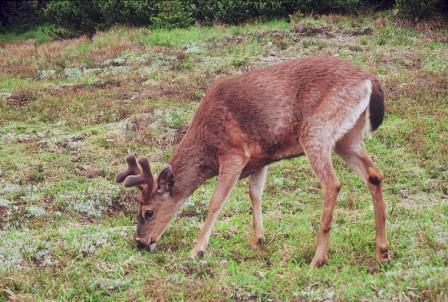
| Scientific Name: | Odocoileus hemionus |
|---|---|
| English Name: | Mule Deer |
| English Name Synonyms: |
Black-tailed Deer
|
| Provincial Status Summary | |
| Status: | S5 |
| Date Status Assigned: | January 15, 2007 |
| Date Last Reviewed: | March 11, 2024 |
| Reasons: | Mule Deer occur throughout BC. They are most common in the southern interior and northeastern portions of the province while remaining absent or sparse in coastal forests and northwestern BC. They are introduced to Haida Gwaii. Trends are relatively stable. |
| Range | |
| Range Extent: | G = 200,000-2,500,000 square km |
| Range Extent Estimate (km2): | 944,730 square km. |
| Range Extent Comments: | Within British Columbia, there are three subspecies of Mule Deer. Odocoileus hemionus hemionus are distributed throughout much of the interior, east of the coastal mountain range to the Alberta border. They are most common in the southern interior and northeastern portions of the province while remaining absent or sparse in coastal forests and northwestern British Columbia. West of the coast range, including Vancouver Island and the Gulf Islands, there are two subspecies of black-tailed deer (O. h. columbiana along the south coast and O. h. sitkensis north of Rivers Inlet), which inhabit coastal forests north to Glacier Bay National Park of Alaska. The coast mountain range represents the approximate zone of subspecies overlap and will provide a boundary for the western most distribution of O. h. hemionus (Cowan and Guiget 1973). Blacktail deer (O.h.sitkensis) are introduced and now widely spread on Haida Gwaii (Cowan and Guiget 1973). |
| Occurrences & Population | |
| Number of Occurrences: | Rank Factor not assessed |
| Comments: | The element occurrence concept for mammals with large home ranges does not always best represent the rarity category as used when calculating the status rank using NatureServe methods. Population size and other factors will be weighted (L. Gelling, pers. comm. 2024). |
| Number of Occurrences with Good Viability / Ecological Integrity: | Rank Factor not assessed |
| Number of Occurrences Appropriately Protected & Managed: | Rank Factor not assessed |
| Population Size: | G = 100,000 - 1,000,000 individuals |
| Comments: | 2022 population estimates for Coastal Blacktail Deer subspecies are 99,000 to 155,000 and for Mule Deer subspecies are 100,000 to 170,000 for a total of 199,000 to 325,000 (B.C. Ministry of Water, Land and Resource Stewardship 2022). |
| Threats (to population, occurrences, or area affected) | |
| Degree of Threat: | Rank Factor not assessed |
| Comments: | Chronic Wasting Disease (CWD) was first found in British Columbia in 2024 in the Kootenays, with one infected Mule Deer and one infected White-tailed Deer. The disease causes premature death in deer, moose, elk and caribou and can, in the long term, cause local extirpations and declines in populations (B.C. Ministry of Water, Land and Resource Stewardship 2024). |
| Trend (in population, range, area occupied, and/or condition of occurrences) | |
| Short-Term Trend: | G = Relatively Stable (<=10% change) |
| Comments: | Population trends vary from one area of the province to another with some increasing and some decreasing (B.C. Ministry of Water, Land and Resource Stewardship 2022; Mule Deer Technical Committee 2023). |
| Long-Term Trend: | H = Increase of 10-25% |
| Comments: | There is no estimate of the size of the increase of Mule Deer in BC from historical levels, but one Mule Deer subspecies has expanded northward from the range mapped in Cowan and Guiget (1973) and now occurs in the Yukon and Alaska (Mule Deer Technical Working Group 2023). |
| Other Factors | |
| Intrinsic Vulnerability: | C=Not intrinsically vulnerable |
| Environmental Specificity: | D=Broad. Generalist or community with all key requirements common. |
| Other Rank Considerations: | |
| Information Gaps | |
| Research Needs: | |
| Inventory Needs: | |
| Stewardship | |
| Protection: | |
| Management: | Best management practices for Chronic Wasting Disease can be found at https://cwd-info.org/ |
| Version | |
| Author: | Fraser, D.F. (2023) |
| Date: | November 29, 2023 |
| References | |
|
British Columbia Ministry of Water, Land and Resource Stewardship. 2024. B.C. responds to first cases of chronic wasting disease in deer. Information bulletin (February 1st, 2024). https://news.gov.bc.ca/releases/2024WLRS0005-000125 Accessed April 24, 2024.
|
|
|
Cowan, I.M. and C.J. Guiguet. 1973. Mammals of British Columbia. BC Provincial Museum Guidebook 11. Victoria BC. 413 pp.
|
|
|
Mule Deer Working Group Technical Committee. 2023. Range-wide status of Black-tailed and Mule Deer Western Association of Fish and Wildlife Agencies. 41 pp.
|
|
Please visit the website Conservation Status Ranks for information on how the CDC determines conservation status ranks. For global conservation status reports and ranks, please visit the NatureServe website http://www.natureserve.org/.
Suggested Citation:
B.C. Conservation Data Centre. 2023. Conservation Status Report: Odocoileus hemionus. B.C. Minist. of Environment. Available: https://a100.gov.bc.ca/pub/eswp/ (accessed Apr 17, 2026).