
BC Conservation Data Centre: Conservation Status Report
Ambystoma gracile
Northwestern Salamander
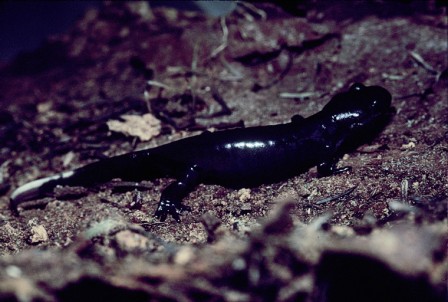
| Scientific Name: | Ambystoma gracile |
|---|---|
| English Name: | Northwestern Salamander |
| Provincial Status Summary | |
| Status: | S4 |
| Date Status Assigned: | March 23, 2022 |
| Date Last Reviewed: | March 23, 2022 |
| Reasons: | Many stable populations exist throughout the historical range in the Pacific Northwest and appears to have a moderate level of threats. |
| Range | |
| Range Extent: | F = 20,000-200,000 square km |
| Range Extent Estimate (km2): | 186,830 |
| Range Extent Comments: | Found all along the west coast of mainland BC, west of the Coast and Cascade mountain ranges north to Prince Rupert and Terrace, throughout Vancouver Island and the lower mainland (Matsuda et al. 2006; iNaturalist Accessed 19-February 2022). |
| Area of Occupancy (km2): | G = 501-2,500 |
| Area of Occupancy Estimate (km2): | 1012 |
| Area of Occupancy Comments: | Minimum based only on iNaturalist records (Accessed 19-February 2022). |
| Occurrences & Population | |
| Number of Occurrences: | D = 81 - 300 |
| Comments: |
Occurrences are based on evidence of historical presence, or current and likely recurring presence, at a given location. Such evidence minimally includes collection or reliable observation and documentation of one or more individuals (including larvae or eggs) in or near appropriate habitat where the species is presumed to be established and breeding. Separation distance is one km of unsuitable habitat and three of suitable (NatureServe Accessed: February 19, 2022) |
| Number of Occurrences with Good Viability / Ecological Integrity: | U = Unknown |
| Number of Occurrences Appropriately Protected & Managed: | U = Unknown |
| Population Size: | Rank Factor not assessed |
| Threats (to population, occurrences, or area affected) | |
| Degree of Threat: | C = Medium |
| Comments: |
An expert threats assessment was conducted on Feb. 28, 2022 with a resulting score of Medium. Loss and degradation of wetlands is likely the greatest concern for this species. They can survive in human constructed ponds in urban situations such as these stormwater ponds in Portland where they were found over a time frame of 12 years (Eckman 2021). Roads are barriers to dispersal and also pose a proximate threat. Introduced fish either extirpate or have significant negative impacts on salamander larvae. However, under certain circumstance the salamander larvae may coexist with introduced fish (Tyler et al. 1998; Funk and Dunlap 1999, Leonard et al. 1993). Given their ability to persist in a varity of wetlands it is likely that threats are "low", however they may be considered "Unknown" until a formal assessment is undertaken by experts (L. Gelling, pers. comm. 2016). |
| Trend (in population, range, area occupied, and/or condition of occurrences) | |
| Short-Term Trend: | U = Unknown |
| Long-Term Trend: | U = Unknown |
| Comments: | Globally considered relatively stable although there has likely been some loss over the long term due to drainage of wetlands for commercial, residential and agricultural development. |
| Other Factors | |
| Intrinsic Vulnerability: | B=Moderately vulnerable |
| Environmental Specificity: | BC=Narrow to moderate. |
| Other Rank Considerations: | |
| Information Gaps | |
| Research Needs: | |
| Inventory Needs: | |
| Stewardship | |
| Protection: | |
| Management: | |
| Version | |
| Author: | Gelling, L., L. Ramsay |
| Date: | February 19, 2022 |
| References | |
|
Eckman, M. 2021. Sensitive amphibian populations persist through time using constructed stormwater ponds. Presentation at Urban Ecosystem Research Consortium of Portland/Vancouver 2021 Symposium. https://archives.pdx.edu/ds/psu/35492
|
|
|
Funk, W. C., and W. W. Dunlap. 1999. Colonization of high-elevation lakes by long-toed salamanders (Ambystoma macrodactylum) after the extinction of introduced trout populations. Canadian Journal of Zoology 77:1759-1767.
|
|
|
Leonard, W., H. Brown, L. Jones, K. McAllister, and R. Storm. 1993. Amphibians of Washington and Oregon. Seattle Audubon Soc., The Trailside Ser., Seattle, WA. 168pp.
|
|
|
Matsuda, B.M., D.M. Green and P.T. Gregory. 2006. Royal BC Museum handbook amphibians and reptiles of British Columbia. Royal B.C. Mus., Victoria, BC. 266pp.
|
|
|
Tyler, T., W.J. Liss, L.M. Ganio, G.L. Larson, R. Hoffman, E. Deimling, and G. Lomnicky. 1998a. Interaction between introduced trout and larval salamanders (Ambystoma macrodactylum) in high-elevation lakes. Conservation Biology 12:94-105.
|
|
Please visit the website Conservation Status Ranks for information on how the CDC determines conservation status ranks. For global conservation status reports and ranks, please visit the NatureServe website http://www.natureserve.org/.
Suggested Citation:
B.C. Conservation Data Centre. 2022. Conservation Status Report: Ambystoma gracile. B.C. Minist. of Environment. Available: https://a100.gov.bc.ca/pub/eswp/ (accessed Jun 3, 2026).