
BC Conservation Data Centre: Conservation Status Report
Eschrichtius robustus
Grey Whale
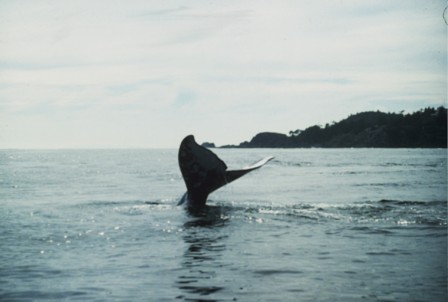
| Scientific Name: | Eschrichtius robustus |
|---|---|
| English Name: | Grey Whale |
| Provincial Status Summary | |
| Status: | S3S4 |
| Date Status Assigned: | January 11, 2023 |
| Date Last Reviewed: | January 11, 2023 |
| Reasons: | Grey Whales use BC waters as a migration corridor between southern and northern breeding grounds. Threats are considered High-medium at the species level and there has been a recent decline in trends. There are three populations of Grey Whale in BC - the Northern Pacific Migratory population (Pop. 4), the Pacific Coast Feeding Group population (Pop. 5), and the Western Pacific (Sakhalin Island) population (Pop. 6). Each population has been assessed separately. Please refer to the Conservation Status Reports using the BC Species and Ecosystems Explorer tool. |
| Range | |
| Range Extent: | G = 200,000-2,500,000 square km |
| Range Extent Comments: | Grey Whales occur in near-shore and inshore waters of British Columbia year round, with the numbers increasing markedly during the migration seasons as individuals moving to and from the Arctic or eastern Russia pass through the area. (COSEWIC 2017d). Three populations of Grey Whale occur within BC waters - the Northern Pacific Migratory population (Pop. 4), the Pacific Coast Feeding Group population (Pop. 5), and a Western Pacific (Sakhalin Island) population (Pop. 6). Refer to the Conservation Status reports for each population for details. |
| Area of Occupancy Comments: | Area of occupancy has not been calculated for BC. |
| Occurrences & Population | |
| Number of Occurrences: | U = Unknown |
| Comments: | The number of occurrences has not been calculated for Grey Whale. Their high mobility makes the concept of number of occurrences difficult to apply. |
| Number of Occurrences with Good Viability / Ecological Integrity: | Rank Factor not assessed |
| Percent Area with Good Viability / Ecological Integrity: | F = Excellent (>40%) |
| Comments: | Northern Pacific Migratory population (Pop. 4): >40%; the Pacific Coast Feeding Group population (Pop. 5): >40%; Western Pacific (Sakhalin Island) population (Pop. 6): Unknown (J. Ford, pers. comm. 2021). Refer to the Conservation Status reports for each population for details. |
| Number of Occurrences Appropriately Protected & Managed: | Rank Factor not assessed |
| Population Size: | F = 10,000 - 100,000 individuals |
| Comments: | Number of mature individuals for each population (COSEWIC 2017d): Northern Pacific Migratory population (Pop. 4): 12,348; the Pacific Coast Feeding Group population (Pop. 5): 146; Western Pacific (Sakhalin Island) population (Pop. 6): 192-246. However, since 2015, Northern Pacific Migratory population has declined by ~38% to approximately 7,800 mature individuals as of 2022 (Eguchi et al. 2022; Moore et al. 2022).Refer to the Conservation Status reports for each population for details. |
| Threats (to population, occurrences, or area affected) | |
| Degree of Threat: | AC = Very high - medium |
| Comments: | Threats for each population were assessed in 2017 (COSEWIC 2017d). Northern Pacific Migratory population (Pop. 4): Medium-low; Pacific Coast Feeding Group population (Pop. 5): High-medium; Western Pacific (Sakhalin Island) population (Pop. 6): Very High-high. However, since then the Northern Pacific Migratory population has shown a sharp decline between 2015 and 2022, possibly driven by poor feeding conditions in their main feeding grounds in the Bering and Chukchi seas (Moore et al. 2022). Refer to the Conservation Status reports for each population for details. |
| Trend (in population, range, area occupied, and/or condition of occurrences) | |
| Short-Term Trend: | E = Decline of 30-50% |
| Comments: | Shore-based counts of southward migrating Grey Whales off southern California show that estimated abundance has declined sharply from a peak of about 29,000 in 2014-15 to 16,650 in 2021-22 (Eguchi et al. 2022). This estimate likely includes all three populations, all of which are known to migrate to Baja California. However, it is not known if the Pacific Coast Feeding Group (Pop. 5) and Western Pacific population (Pop. 6) have experienced such a decline. |
| Long-Term Trend: | U = Unknown |
| Comments: | Long-term trends are unknown for all three populations. Refer to the Conservation Status reports for each population for details. |
| Other Factors | |
| Intrinsic Vulnerability: | Rank Factor not assessed |
| Comments: | Refer to the Conservation Status reports for each population for details. |
| Environmental Specificity: | Rank Factor not assessed |
| Comments: | Refer to the Conservation Status reports for each population for details. |
| Other Rank Considerations: | |
| Information Gaps | |
| Research Needs: | |
| Inventory Needs: | |
| Stewardship | |
| Protection: | |
| Management: | |
| Version | |
| Author: | Ford, J. |
| Date: | January 11, 2023 |
| References | |
|
COSEWIC. 2017d. COSEWIC assessment and status report on the Grey Whale Eschrichtius robustus, Northern Pacific Migratory population, Pacific Coast Feeding Group population and the Western Pacific population, in Canada. Committee on the Status of Endangered Wildlife in Canada. Ottawa. xxi + 74 pp.
|
|
Please visit the website Conservation Status Ranks for information on how the CDC determines conservation status ranks. For global conservation status reports and ranks, please visit the NatureServe website http://www.natureserve.org/.
Suggested Citation:
B.C. Conservation Data Centre. 2023. Conservation Status Report: Eschrichtius robustus. B.C. Minist. of Environment. Available: https://a100.gov.bc.ca/pub/eswp/ (accessed Apr 28, 2026).