
BC Conservation Data Centre: Conservation Status Report
Eumetopias jubatus
Steller Sea Lion
| Scientific Name: | Eumetopias jubatus |
|---|---|
| English Name: | Steller Sea Lion |
| English Name Synonyms: |
Northern Sea Lion
|
| Provincial Status Summary | |
| Status: | S3S4B,S4N |
| Date Status Assigned: | March 14, 2022 |
| Date Last Reviewed: | March 14, 2022 |
| Reasons: | There are few breeding rookeries concentrated in five areas. They are also concentrated outside of breeding season around haulouts. Breeding population was severely reduced by deliberate culls; but has recovered in B.C. Possibly threatened by competition with commercial fisheries, toxic pollutants, and harassment. |
| Range | |
| Range Extent: | F = 20,000-200,000 square km |
| Range Extent Comments: | The range extent is estimated to be approximately 65, 000 km squared (COSEWIC 2013d) |
| Area of Occupancy (km2): | EF = 26-500 |
| Area of Occupancy Comments: | The rookeries would cover less than 10km squared. |
| Occurrences & Population | |
| Number of Occurrences: | AB = 1 - 20 |
| Comments: |
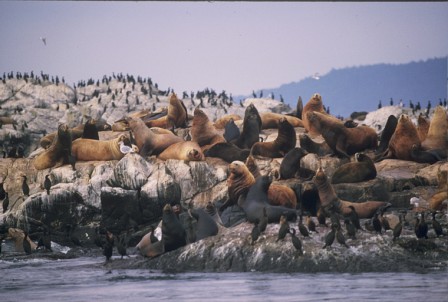
Five main breeding areas in British Columbia: 1) the Scott Islands off the northwestern tip of Vancouver Island, with rookeries situated on Triangle, Sartine and Maggot Islands; 2) Cape St.James off the southern tip of Haida Gwaii, with rookeries situated on the Kerouard Islands; 3) Garcin Rocks off the east coast of South Moresby Island, Haida Gwaii, 4) off Banks Island on the northern mainland coast, with rookeries situated on North Danger Rocks, and 5) Virgin Rocks (part of the Sea Otter Group located in Queen Charlotte Sound off the central mainland near Calvert Island). There are about 30 haulout sites distributed mainly along the exposed outer coast that are used throughout the year, as well as additional winter sites used on a seasonal or irregular basis (COSEWIC 2013d). There are winter haulouts mapped as element occurrences which makes the number of occurrences much higher than indicated here -the number here refers to just the rookeries which are used for ranking purposes. |
| Number of Occurrences with Good Viability / Ecological Integrity: | Rank Factor not assessed |
| Number of Occurrences Appropriately Protected & Managed: | BC = 1 - 12 |
| Comments: | The Scott Islands, which include Beresford Island, Sartine Island, and Triangle Island, are ecological reserves which are closed to the public due to the sensitive nature of the area. |
| Population Size: | F = 10,000 - 100,000 individuals |
| Comments: |
The total BC population was about 28,600 in 2010 (range 27,100 - 29,500; Olesiuk 2011), of which ~11,500 were mature animals (~40%). Numbers of non-pups counted at rookeries and haulouts in BC suggest there may be as many 32,000 Steller Sea Lions in summer (range 27,200 - 36,700) and as many as 48,000 in winter (95% CI 37,900 - 58,300) due to the large rookery that occurs on Forrester Island just north of the British Columbia-Alaska border and an influx of sea lions from Washington and Oregon (Olesiuk 2011). |
| Threats (to population, occurrences, or area affected) | |
| Degree of Threat: | BD = High - low |
| Comments: |
Small numbers are believed to be shot each year (illegal and licensed predator control), and larger numbers may be incidentally taken in fishing gear, or entangled and die in debris. Contaminants can impair reproduction and survival, and there is a constant potential for acute oil spills to kill large numbers of sea lions near rookeries and haulouts. Steller Sea Lions are also easily disturbed and may abandon terrestrial sites or be displaced by Human activities (COSEWIC 2013d). Changes in environmental conditions, effects of commercial fishing on the food resources, high levels of organochlorine pollutants, and shooting have been cited as possible threats, but none has been directly related to population trends and it is unclear to what extent they may affect the population (National Marine Fisheries Service 1992). Close approach by humans, boats, or aircraft will cause hauled-out sea lions to go into the water. Areas subjected to repeated disturbances may be permanently abandoned (Kenyon 1962). Repeated abandonment of the pups could negatively affect the condition and survival of the pups (National Marine Fisheries Service 1992). |
| Trend (in population, range, area occupied, and/or condition of occurrences) | |
| Short-Term Trend: | HI = Increase of >10% |
| Comments: | Population increases have been observed since Steller Sea Lions were protected in 1970, but most of this increase occurred since 1990. Numbers of non-pups on rookeries and haulouts were stable from 1971-1983, but increased at a mean rate of 4.7% since the mid-1980s. In contrast, pups increased slowly at an annual rate of 1.7% per year from 1971-1994, and at 7.3% per year since the mid-1990s. This has resulted in a 4-5 fold increase in the size of the population in B. C. since the 1970s, and the establishment of two new rookeries, and a more than doubling in numbers of year round haulout sites. Based on pup counts the percent increase in total number of mature individuals over the last 3 generations (i.e., 30-33 years, 1977-2010) was >450%. This inferred rate of increase assumes constant birth rates and a relatively constant ratio of breeding females to bulls over time (Olesiuk 2011 in COSEWIC 2013d). |
| Long-Term Trend: | Rank Factor not assessed |
| Comments: |
The population of Northern Sea Lions in British Columbia was reduced from about 14,000 to 3,800 between 1900 and 1970 as a result of deliberate culls (Bigg 1988). The population in 2010 appeared to be slightly larger than it was before harvesting and predator-control programs were begun in the early 1900s. |
| Other Factors | |
| Intrinsic Vulnerability: | Rank Factor not assessed |
| Environmental Specificity: | Rank Factor not assessed |
| Other Rank Considerations: | |
| Information Gaps | |
| Research Needs: | |
| Inventory Needs: | Aerial surveys of Northern Sea Lion rookeries to estimate abundance should be continued (Barlow et al. 1997). |
| Stewardship | |
| Protection: | |
| Management: | The protection of two rookeries on Danger Rocks and Cape St. James as well as major haulout sites is important. In Alaska, there is a 10 nautical mile no trawling zone and a 3 nautical mile no fishing zone around all rookeries and haulout sites; however, the effect of this protection has not been determined (R. Merrick, pers. comm.). Identify and designate 'critical habitat' areas after considering all rookeries, major haulout sites, and important feeding areas (National Marine Fisheries Service 1992). Knowledge of the factors limiting the population, actions necessary to stop the population decline, and actions necessary to allow the population to increase (National Marine Fisheries Service 1992). |
| Version | |
| Author: | Ramsay, L. and S. Cannings |
| Date: | November 12, 2013 |
| References | |
|
Fritz, L., B. Brost, E. Laman, et al. 2019. A re-examination of the relationship between Steller sea lion (Eumetopias jubatus) diet and population trend using data from the Aleutian Islands." Canadian Journal of Zoology 97:1137-1155. |
|
|
Pynn, L. 2020. What Would a British Columbia Seal and Sea Lion Cull Actually Entail? Hakai Magazine, 22 October 2020 |
|
|
Barlow, J., K.A. Forney, P.S. Hill, R.L. Brownell, J.V.Carretta, D.P. DeMaster, F. Julian, M.S. Lowry, T. Ragen, and R.R. Reeves. 1997. U.S. Pacific Marine Mammal Stock Assessments: 1996. NOAA Tech. Memo. NMFS. NOAA-TM-NMFS-SWFSC-248.
|
|
|
Bigg, M.A. 1985. Status of the Steller Sea Lion (Eumetopias jubatus) and California Sea Lion (Zalophus californianus) in British Columbia. Can. Spec. Publ. Fish. and Aquatic Sci. No. 77.
|
|
|
Bigg, M.A. 1988. Status of the Steller sea lion, Eumetopias jubatus, in Canada. Can. Field-Nat. 102:315-336.
|
|
|
Calkins, D.G. and K.W Pitcher. 1982. Population assessment, ecology, and trophic relationships of Steller sea lions in the Gulf of Alaska. Final report for Outer Continental Shelf Environmental Assessment Program. Alaska Dept. Fish and Game, Anchorage, AK.Bureau of Land Mangement. 129 p.
|
|
|
COSEWIC. 2013d. COSEWIC assessment and status report on the Steller Sea Lion Eumetopias jubatus in Canada. Committee on the Status of Endangered Wildlife in Canada. Ottawa. xi + 54 pp.
|
|
|
DeLong, R.L., W.G. Gilmartin, and J.G. Simpson. 1973. Premature births in California sea lions: association with high organochlorine pollutant residue levels. Science 181:1168-1170.
|
|
|
DFO (Department of Fisheries and Oceans). 2021. Trends in abundance and distribution of Steller Sea Lions (Eumetopias Jubatus) in Canada. DFO Can. Sci. Advis. Sec. Sci. Advis. Rep. 2021/035.
|
|
|
Edie, A.G. 1977. Distribution and movements of Steller sea lion cows (Eumetopias jubatus) on a pupping colony. M.Sc. Thesis, Univ. B.C., Vancouver, BC.
|
|
|
Fiscus, C.H. and G.A. Baines. 1966. Food and feeding behavior of Steller and California sea lions. J. Mamm. 47(2):195-200.
|
|
|
Ford, J.K.B. 2014. Marine Mammals of British Columbia. Royal BC Museum Handbook, Mammals of BC, volume 6. Royal B.C. Mus., Victoria, BC. 460 pp.
|
|
|
Fraker, B.A., and B.R. Mate. 1999. Seals, sea lions, and salmon in the Pacific Northwest. Pages xx in J.R. Twiss, and R.R. Reeves, eds. Marine Mammals, vol. 2, Management. Smithsonian Press, Washington, DC. In press.
|
|
|
Gentry, R.L. 1970. Social behavior of the Steller sea lion. Ph.D. thesis. Univ. of California, Santa Cruz, CA. 113 p.
|
|
|
Gilmartin, W.G., R.L. DeLong, A.W. Smith, J.C. Sweeney, B.W. DeLappe, R.W. Risebrough, L.A. Griner, M.D. Dailey, and D.B. Peakall. 1976. Premature parturition in the California sea lion. J.Wildl. Diseases 12:104-115.
|
|
|
Harrison, R.J. 1969. Reproduction and reproductive organs. Pages 253-384 in H.T. Anderson, ed. The biology of marine mammals. Acad. Press, New York, NY.
|
|
|
Harwood, J., and J.P. Croxall. 1988. The assessment of competition between seals and commercial fisheries in the North Sea and the Antarctic. Marine Mammal Sci. 4:13-33.
|
|
|
Kenyon, K.W. 1962. History of the Steller sea lion at the Pribilof islands, Alaska. J. Mammal. 43:68-75.
|
|
|
Loughlin, T. R., D. J. Rugh, and C. H. Fiscus. 1984. Northern sea lion distribution and abundance: 1956-1980. J. Wildlife Management 48:729-740.
|
|
|
Loughlin, T.R. 1997. Using the phylogeographic method to identify Steller sea lion stocks. Pages 159-171 in A.E. Dizon, S.J. Chivers, and W.F. Perrin, eds. Molecular genetics of marine mammals. The Soc. for Marine Mammal. Spec. Publ. No. 3.
|
|
|
Loughlin, T.R., and R.L. Merrick. 1989. Comparison of commercial harvest of walleye pollock and the northern sea lion abundance in the Bering Sea and the Gulf of Alaska. Pages 679-700, in Proc. Inter. symp. on the biol. and manage. of walleye pollock, 14-16 November 1988, Anchorage, AK. Univ. Alaska Sea Grant Rep. AK-SG-89-01.
|
|
|
Lowry, L.F., K.J. Frost, D.G. Calkins, G.L. Swartzman, and S. Hills. 1982. Feeding habits, food requirements, and status of Bering Sea marine mammals. North Pacific Fishery Manage. Council, Anchorage, AK. Document No. 19.
|
|
|
Mathisen, O.A., R.T. Baade, and R.J. Lopp. 1962. Breeding habits, growth and stomach contents of the Steller sea lion in Alaska. J. Mammal. 43:464-477.
|
|
|
National Marine Fisheries Service. 1992. Recovery Plan for the Steller Sea Lion (Eumetopias jubatus). Natl. Marine Fish. Serv., Silver Spring, MD. 92pp.
|
|
|
Olesiuk, P.F. 2011. Abundance of Steller sea lions (Eumetopias jubatus) in British Columbia. Canadian Science Advisory Secretariat Research Document 2010/000:1-43. (as cited in COSEWIC 2013; original unavailable).
|
|
|
Olesiuk, P.F. 2018. Recent trends in Abundance of Steller Sea Lions (Eumetopias jubatus) in British Columbia. DFO Can. Sci. Advis. Sec. Res. Doc. 2018/006. v + 67 p.
|
|
|
Olesiuk, P.F., M.A. Bigg, G.M. Ellis, S.J. Crockford, and R.J. Wigen. 1990. An assessment on the feeding habits of harbour seals (Phoca vitulina) in the Strait of Georgia, British Columbia, based on scat analysis. Can. Tech. Rep. Fish. Aquat. Sci. No. 1730.
|
|
|
Perlov, A.S. 1971. The onset of sexual maturity in sea lions. Proc. All Union Inst. Mar. Fish. and Oceanography 80:174-187.
|
|
|
Pike, G.C., and B.E. Maxwell. 1958. The abundance and distribution of the northern sea lion (Eumetopias jubatus) on the coast of British Columbia. J. Fish. Res. Board of Can. 13:5-17.
|
|
|
Pitcher, K.W. 1981. Prey of Steller sea lion, Eumetopias jubatus, in the Gulf of Alaska. Fish. Bull. 79:467-472.
|
|
|
Pitcher, K.W., and D.G. Calkins. 1981. Reproductive biology of the Steller sea lion in the Gulf of Alaska. J. Mammal. 62:599-605.
|
|
|
Sandegren, F.E. 1970. Breeding and maternal behavior of the Steller sea lion (EUMETOPIAS JUBATA) in Alaska. M.S. thesis. Univ. of Alaska Fairbanks, Fairbanks, AK. 138 p.
|
|
|
Schusterman, R. J. 1981. Steller sea lion Eumetopias jubatus (Schreber, 1776). Pages 119-141 in S. H. Ridgway and R. J. Harrison, editors. Handbook of marine mammals. Vol. 1. The walrus, sea lions, fur seals and sea otter. Academic Press, New York.
|
|
|
Spalding, D.J. 1964. Comparative feeding habits of the fur seal, sea lion and the harbour seal on the British Columbia coast. Bull. Fish. Res. Board Can. 146:1-52.
|
|
|
Walters, C.J., McAllister, M.K. and Christensen, V. 2020. Has Steller Sea Lion predation impacted survival of Fraser River Sockeye Salmon?. Fisheries, 45(11), pp.597-604.
|
|
|
York, A.E. 1994. The population dynamics of northern sea lions, 1975-1985. Marine Mammal Sci. 10:38-51.
|
|
Please visit the website Conservation Status Ranks for information on how the CDC determines conservation status ranks. For global conservation status reports and ranks, please visit the NatureServe website http://www.natureserve.org/.
Suggested Citation:
B.C. Conservation Data Centre. 2013. Conservation Status Report: Eumetopias jubatus. B.C. Minist. of Environment. Available: https://a100.gov.bc.ca/pub/eswp/ (accessed Jun 2, 2026).