
BC Conservation Data Centre: Conservation Status Report
Pseudacris regilla
Pacific Treefrog
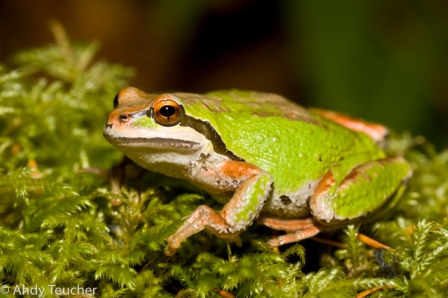
| Scientific Name: | Pseudacris regilla |
|---|---|
| English Name: | Pacific Treefrog |
| English Name Synonyms: |
Northern Pacific Treefrog
Pacific Chorus Frog Pacific Treefrog |
| Provincial Status Summary | |
| Status: | S5 |
| Date Status Assigned: | December 31, 2016 |
| Date Last Reviewed: | March 23, 2023 |
| Reasons: | Northern Pacific Treefrog is common and widely distributed throughout its range; threats are considered to be low. |
| Range | |
| Range Extent: | G = 200,000-2,500,000 square km |
| Range Extent Estimate (km2): | 414,895 |
| Range Extent Comments: |
Found in the southern third of British Columbia (including Vancouver Island) as far north as Quesnel and McBride in the interior, Terrace along the coast and as far east as Cranbrook and Golden (Matsuda et al. 2006, iNaturalist; Accessed 26-February-2022). There is an introduced population on Haida Gwaii (Matsuda et al. 2006). This was not used in the Range Extent calculation . |
| Area of Occupancy (km2): | G = 501-2,500 |
| Area of Occupancy Comments: | 4,824 km 2 |
| Occurrences & Population | |
| Number of Occurrences: | E = > 300 |
| Comments: | Represented by many and/or large occurrences throughout most of this species range. |
| Number of Occurrences with Good Viability / Ecological Integrity: | U = Unknown |
| Number of Occurrences Appropriately Protected & Managed: | Rank Factor not assessed |
| Population Size: | U = Unknown |
| Comments: | P. regilla is an abundant and common species throughout its range in British Columbia, exact numbers are not known. |
| Threats (to population, occurrences, or area affected) | |
| Degree of Threat: | D = Low |
| Comments: | An expert threats assessment was conducted in 2023. Roads and shifting habitats as a result of climate change (i.e., degradation and loss of wetland habitats) were identified as primary threats for this species. Although the species' range overlaps with the geographic area of the province that has extensive land use for agriculture and forestry, a variety of non-native vertebrate predators occur in aquatic habitats, and there is relatively high development pressure. This is a generalist species that occurs in and exploits a variety of habitat types and elevations and is adaptable to habitat change. |
| Trend (in population, range, area occupied, and/or condition of occurrences) | |
| Short-Term Trend: | U = Unknown |
| Long-Term Trend: | U = Unknown |
| Other Factors | |
| Intrinsic Vulnerability: | BC=Moderately vulnerable to not intrinsically vulnerable. |
| Comments: | Juvenile frogs disperse only short distances, e.g. within 200m from their natal pond (Astley 2005) which may limit recolonization. These frogs are also prone to limb malformations (Astley 2005). |
| Environmental Specificity: | D=Broad. Generalist or community with all key requirements common. |
| Comments: | P. regilla is a generalist species which can utilize a broad variety of habitats. In breeding season, they can be found almost anywhere there is shallow standing water (Matsuda et al. 2006) |
| Other Rank Considerations: | |
| Information Gaps | |
| Research Needs: | |
| Inventory Needs: | |
| Stewardship | |
| Protection: | |
| Management: | |
| Version | |
| Author: | Gelling, L and L. Ramsay |
| Date: | November 28, 2016 |
| References | |
|
Dang T.D., C.L. Searle, A.R. Blaustein. 2017. Virulence variation among strains of the emerging infectious fungus Batrachochytrium dendrobatidis (Bd) in multiple amphibian host species. Dis Aquat Org 124:233-239
|
|
|
Govindarajulu et al. 2013. Batrachochytrium dendrobatidis surveillance in British Columbia 2008-2009, Canada. 5pp.
|
|
|
Matsuda, B.M., D.M. Green and P.T. Gregory. 2006. Royal BC Museum handbook amphibians and reptiles of British Columbia. Royal B.C. Mus., Victoria, BC. 266pp.
|
|
Please visit the website Conservation Status Ranks for information on how the CDC determines conservation status ranks. For global conservation status reports and ranks, please visit the NatureServe website http://www.natureserve.org/.
Suggested Citation:
B.C. Conservation Data Centre. 2016. Conservation Status Report: Pseudacris regilla. B.C. Minist. of Environment. Available: https://a100.gov.bc.ca/pub/eswp/ (accessed Feb 10, 2026).