
BC Conservation Data Centre: Conservation Status Report
Mirounga angustirostris
Northern Elephant Seal
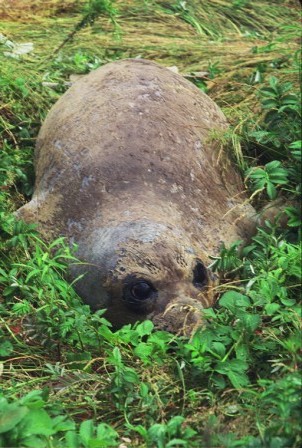
| Scientific Name: | Mirounga angustirostris |
|---|---|
| English Name: | Northern Elephant Seal |
| Provincial Status Summary | |
| Status: | S1B,S4N |
| Date Status Assigned: | March 11, 2022 |
| Date Last Reviewed: | March 11, 2022 |
| Reasons: | Elephant Seals breed at only one location, Race Rocks, in BC. Non-breeding seals occur within BC waters and haul out at about 20 locations on Vancouver Island and Haida Gwaii. Threats are considered low for this species and the numbers of seals foraging in BC waters has likely increased by several orders of magnitude since the late 1800s. |
| Range | |
| Range Extent: | FG = 20,000-2,500,000 square km |
| Range Extent Comments: | Northern Elephant Seals are found in both offshore and inshore waters of BC, including the Strait of Georgia and deep fjords and channels on the central and northern mainland coast (Ford 2014). Most of the population breeds at rookeries on about 13 islands and 5 mainland sites in Baja California, Mexico and California, USA (Lowry et al. 2014). In BC, they only haulout in small numbers in a few scattered locations. There is a small number of breeding males (typically < 3) and females (typically < 5) and that produce pups at Race Rocks off southern Vancouver Island (Ford 2014; Tristan Blaine, Race Rocks Ecological Reserve, pers. comm.). The range extent of the non-breeding population in BC is estimated to be approximately 600,000 km2 (the area of all BC marine waters; COSEWIC 2011). The range extent of the few breeding individuals at Race Rocks is unknown, but presumably is typical of the larger population?s range. |
| Area of Occupancy Estimate (km2): | < 1 km2 at Race Rocks |
| Linear Distance of Occupancy: | A = 1-4 |
| Area of Occupancy Comments: | The Area of Occupancy for the breeding population in BC is < 1 km2, which is the area of Great Race Rock in the Race Rocks group off southern Vancouver Island. The Area of Occupancy for the main breeding population would be the sum of the areas encompassing the ~18 breeding rookeries in Mexico and California, likely <100 km2 in total. Seals have been observed hauled-out on beaches at about 20 locations in BC, on Vancouver Island and on Haida Gwaii (Ford 2014). |
| Occurrences & Population | |
| Number of Occurrences: | A = 1 - 5 |
| Comments: | Northern Elephant Seals forage in both offshore and deep inshore waters off the coast of BC (Ford 2014). Individuals rarely haul out in BC but some do in order to moult (mostly subadults) and some to mate and give birth. Seals have been observed hauled-out on beaches at about 20 locations in BC, mostly around southern Vancouver Island but also on northern and western Vancouver Island and on Haida Gwaii (Ford 2014). There is only one occurrence of breeding animals in BC, that being on Great Race Rock off southern Vancouver Island. |
| Number of Occurrences with Good Viability / Ecological Integrity: | B = 1 - 3 |
| Comments: | The single breeding occurrence of Northern Elephant Seal is at the Race Rocks Ecological Reserve. |
| Number of Occurrences Appropriately Protected & Managed: | B = 1 - 3 |
| Comments: | The single breeding site in BC is within the Race Rocks Ecological Reserve. |
| Population Size: | A = 1 - 50 individuals |
| Comments: | Once driven to near extinction by sealing, the abundance of Northern Elephant Seals has increased strikingly, especially in the past 50 years. The total population size in 2010 was estimated from pup production in California and Mexico to be between 210,000 and 239,000 animals (Lowry et al. 2014). Assuming 50% of seals are mature (as per IUCN, Hückstadt 2015), abundance in 2010 would be about 105,000?120,000 individuals in the overall NE Pacific population. The abundance rating for this total abundance would be G=100,000?1,000,000. The proportion of the overall population that makes use of BC waters for foraging is unknown. The abundance of seals at the only breeding site in BC, at Race Rocks, varies from year to year but has been as high as 20-25 in recent years (Ford 2014), or around 10-12 mature individuals. The abundance rating of A=1-50 is applied to the breeding population in BC and is unknown for the non-breeding population in BC. |
| Threats (to population, occurrences, or area affected) | |
| Degree of Threat: | U = Unknown |
| Comments: | No threats calculator exercise has been conducted for breeding or non-breeding Northern Elephant Seal in Canada. The species generally is at low risk from anthropogenic threats. It forages widely across NE Pacific pelagic waters on deep water fishes and squid that are not currently a target of human fisheries. It breeds on rookeries in California and Mexico that are protected from disturbance. A few deaths are reported annually due to entanglement in debris or fishing gear, or strikes from vessels, but these are not significant at the population level (Ford 2014; Carretta et al. 2021). |
| Trend (in population, range, area occupied, and/or condition of occurrences) | |
| Short-Term Trend: | G = Relatively Stable (<=10% change) |
| Comments: | Overall population increase over past 3 generations (or 27 years) in NE Pacific is +3.8%/yr. Numbers low but stable at Race Rocks, which is used for short-term trend rating. |
| Long-Term Trend: | U = Unknown |
| Comments: | Northern Elephant Seals were reduced by sealing in the 1800s to a remnant population of fewer than 100 by the 1890s (Ford 2014). The population recovered slowly during the first half of the 20th century then began expanding rapidly. During 1958 to 1987, abundance grew at an average annual rate of 17%, which then slowed to an average of 3.8% annually from 1987-2010 (Lowry et al. 2014). Thus, the numbers of seals foraging in BC waters has likely increased by several orders of magnitude since the late 1800s. There does not appear to be any evidence that Northern Elephant Seals bred in BC historically. Elephant Seal bones have been found at a few archaeological sites on the west coast Vancouver Island, dating as far back as 1,200 to 2,400 years ago (McKechnie and Wigen 2011), but it is unknown whether these were taken on land or at sea. Seals began hauling out at Race Rocks in the mid 1990s and the first birth was recorded there in 2009 (racerocks.ca). About 3-5 pups have been born there annually in recent years (Ford, 2014; Tristan Blaine, pers. comm. 2022). Long-term trend for the breeding population cannot be assessed; however, for the non-breeding population, a score of 'I' (>25%) is appropriate. |
| Other Factors | |
| Intrinsic Vulnerability: | C=Not intrinsically vulnerable |
| Comments: | Northern Elephant Seals are exposed to relatively low levels of anthropogenic threats. Their only significant predators are Killer Whales and White Sharks. |
| Environmental Specificity: | CD = Moderate to broad. |
| Comments: | Northern Elephant Seals are deep diving animals that forage on a variety of demersal fishes and squids over a wide area of pelagic and inshore NE Pacific waters. They breed at ~20 sites in California and Mexico, and 1 site in BC. |
| Other Rank Considerations: | |
| Information Gaps | |
| Research Needs: | Determining the paternity of seals born at Race Rocks would be useful to understand whether matings observed there result in pups born at that location. |
| Inventory Needs: | Continued monitoring of seals, including reproduction, at Race Rocks |
| Stewardship | |
| Protection: | |
| Management: | |
| Version | |
| Author: | Ford, J. |
| Date: | March 16, 2022 |
| References | |
|
Hückstädt, L. 2015. Mirounga angustirostris. The IUCN Red List of Threatened Species 2015: e.T13581A45227116. |
|
|
Carretta, J.V., E.M. Oleson, K. Forney et al. 2021. US Pacific marine mammal stock assessments: 2020. U.S. Department of Commerce, NOAA Technical Memorandum NMFS-SWFSC-646.
|
|
|
COSEWIC. 2011l. COSEWIC assessment and status report on the Humpback Whale Megaptera novaeangliae in Canada. Committee on the Status of Endangered Wildlife in Canada. Ottawa. x + 32 pp.
|
|
|
Ford, J.K.B. 2014. Marine Mammals of British Columbia. Royal BC Museum Handbook, Mammals of BC, volume 6. Royal B.C. Mus., Victoria, BC. 460 pp.
|
|
|
Lowry, M.S., Condit, R., Hatfield, B., et al. 2014. Abundance, Distribution, and Population Growth of the Northern Elephant Seal (Mirounga angustirostris) in the United States from 1991 to 2010. Aquatic Mammals, 40:20-31.
|
|
Please visit the website Conservation Status Ranks for information on how the CDC determines conservation status ranks. For global conservation status reports and ranks, please visit the NatureServe website http://www.natureserve.org/.
Suggested Citation:
B.C. Conservation Data Centre. 2022. Conservation Status Report: Mirounga angustirostris. B.C. Minist. of Environment. Available: https://a100.gov.bc.ca/pub/eswp/ (accessed Jul 8, 2026).