
BC Conservation Data Centre: Conservation Status Report
Pandion haliaetus
Osprey
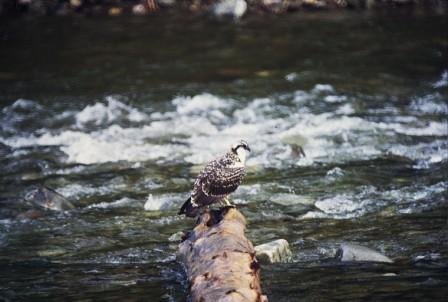
| Scientific Name: | Pandion haliaetus |
|---|---|
| English Name: | Osprey |
| Provincial Status Summary | |
| Status: | S5B |
| Date Status Assigned: | November 29, 2005 |
| Date Last Reviewed: | March 05, 2015 |
| Reasons: | Fairly abundant and widespread breeder. Creston population recently increased. Widespread but moderate numbers of nonbreeders. |
| Range | |
| Range Extent: | H = >2,500,000 square km |
| Range Extent Comments: | Breeds throughout province except on the Queen Charlotte Islands, generally south of latitude 56 degrees N. Breeds from near sea level to 1,070m. Nonbreeders (D) are widely distributed throughout province (Campbell et al. 1990b). |
| Occurrences & Population | |
| Number of Occurrences: | DE = 81 to >300 |
| Comments: | Widespread breeder. Widespread nonbreeder (D). |
| Number of Occurrences with Good Viability / Ecological Integrity: | Rank Factor not assessed |
| Number of Occurrences Appropriately Protected & Managed: | DE = 13 to >40 |
| Comments: | Breeding: Boundary Bay National Wildlife Area, Vaseux Lake Migratory Bird Sanctuary, Chilcotin Lake, Atlin Provincial Park, etc. Nonbreeding: Sorrento Flats, Comox Slough Nature Trust, Swan Lake Nature Trust (Vernon), etc. |
| Population Size: | E = 2,500 - 10,000 individuals |
| Comments: | Widespread breeder south of latitude 56 degrees N (except on Queen Charlotte Islands). Nonbreeders (C?): uncommon to fairly common migrant and summer visitant across the southern third of BC, rare north of latitude 56 degrees N; very rare on Queen Charlotte Islands; In winter very rare on south coast, casual in interior (Campbell et al. 1990b). |
| Threats (to population, occurrences, or area affected) | |
| Degree of Threat: | Rank Factor not assessed |
| Trend (in population, range, area occupied, and/or condition of occurrences) | |
| Short-Term Trend: | GH = Relatively Stable to increase of <25% |
| Comments: | In the Creston area, breeding numbers increased between 1968-1981 at least in part due to the installation of a water management system which increased prey fish abundance (Campbell et al. 1990b). |
| Long-Term Trend: | Rank Factor not assessed |
| Other Factors | |
| Intrinsic Vulnerability: | Rank Factor not assessed |
| Environmental Specificity: | Rank Factor not assessed |
| Other Rank Considerations: | |
| Information Gaps | |
| Research Needs: | |
| Inventory Needs: | |
| Stewardship | |
| Protection: | |
| Management: | |
| Version | |
| Author: | Westereng, L.K. |
| Date: | March 01, 2000 |
| References | |
|
Campbell, R.W., N.K. Dawe, I. McTaggart-Cowan, et al. 1990b. The Birds of British Columbia Vol. 2: Nonpasserines: Diurnal Birds of Prey through Woodpeckers. Royal British Columbia Museum, Victoria, BC.
|
|
Please visit the website Conservation Status Ranks for information on how the CDC determines conservation status ranks. For global conservation status reports and ranks, please visit the NatureServe website http://www.natureserve.org/.
Suggested Citation:
B.C. Conservation Data Centre. 2000. Conservation Status Report: Pandion haliaetus. B.C. Minist. of Environment. Available: https://a100.gov.bc.ca/pub/eswp/ (accessed Jun 10, 2026).