
BC Conservation Data Centre: Conservation Status Report
Callorhinus ursinus
Northern Fur Seal
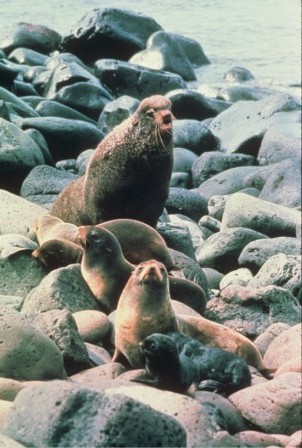
| Scientific Name: | Callorhinus ursinus |
|---|---|
| English Name: | Northern Fur Seal |
| Provincial Status Summary | |
| Status: | S3S4N |
| Date Status Assigned: | January 19, 2022 |
| Date Last Reviewed: | January 19, 2022 |
| Reasons: | Northern Fur Seals are highly migratory and occur in BC primarily offshore, about 20-150 km from the coast, where they feed. Significant threats include entanglement in debris and fishing gear, interaction with fisheries, prey limitation, climate change and oil spills. There have been significant declines due to past harvesting and the population is currently about 70-80% smaller than its size about 270 years ago. |
| Range | |
| Range Extent: | G = 200,000-2,500,000 square km |
| Range Extent Estimate (km2): | 600,000 |
| Range Extent Comments: | Northern Fur Seals are mostly found in offshore waters off the BC coast, particularly on and beyond the continental shelf about 20-150 km from land, but also can be observed in inshore channels and fjords (COSEWIC 2010t; Ford 2014). They rarely haul out on land in BC. The range extent includes both offshore and inshore waters off the BC coast, which is about 600,000 km2 (COSEWIC 2010t). Northern Fur Seals that use BC waters breed mostly at rookeries on islands in the Bering Sea (Pribilof, Bogoslof and, secondarily, Commander islands), and migrate south as far as California (Olesiuk 2012). Greatest numbers of fur seals are present in BC waters during January through June (COSEWIC 2010t). Smaller breeding rookeries are also found on San Miguel and Farallon islands off the coast of southern and central California. Seals from these islands migrate north as far as BC waters (Lea et al. 2009; Carretta et al. 2021). |
| Area of Occupancy (km2): | U = Unknown |
| Area of Occupancy Comments: | It is difficult to determine area of occupancy for such a highly mobile species. The area of occupancy in BC waters is likely similar to the range extent. |
| Occurrences & Population | |
| Number of Occurrences: | U = Unknown |
| Comments: | The number of element occurrences within BC has not been calculated using NatureServe methodology. Northern Fur Seals inhabiting the eastern North Pacific, including those that use BC waters, breed primarily at 7 locations: St. Paul Island, St. George Island, and Sea Lion Rock (all in the Pribilof Island group), Commander Islands (western Bering Sea), Bogoslof Island (in the Aleutian Islands), and San Miguel and Farallon islands (off the coast of California) (COSEWIC 2010t; Olesiuk 2012; Carretta et al. 2021; Muto et al. 2021). Olesiuk (2012) estimated that 75% of Northern Fur Seals using BC waters originate in the Pribilof Islands, 15% from Bogoslof Island, 8% from the Commander Islands. No estimate was provided for those seals originating in California. |
| Number of Occurrences with Good Viability / Ecological Integrity: | Rank Factor not assessed |
| Comments: | The 7 islands containing breeding rookeries used by eastern North Pacific Northern Fur Seals appear to have good viability/ecological integrity. However, pup production on breeding rookeries in the Pribilof Islands, the main source of Northern Fur Seals that use BC waters, has declined significantly since the 1990s for reasons that are unknown. |
| Number of Occurrences Appropriately Protected & Managed: | A = None |
| Population Size: | G = 100,000 - 1,000,000 individuals |
| Comments: | Northern Fur Seal abundance estimates are derived from pup counts on breeding rookeries multiplied by an ?expansion factor? based on life history and demographic parameters to estimate the overall numbers of animals in the population. The most recent estimate for the number of Northern Fur Seals in the eastern North Pacific based on pup production estimates in the eastern Bering Sea (Sea Lion Rock, St. Paul and St. George Islands, and Bogoslof Island) is 608,143 individuals (136,050 pups multiplied by an expansion factor of 4.47 ×) (Muto et al. 2021). In addition to this, a recent abundance estimate for San Miguel and Farallon islands is 14,050 seals (Carretta et al. 2021), giving a total abundance of 622,193 Northern Fur Seals. With about 44% of animals being mature (COSEWIC 2010t), the resulting population size is about 275,000 mature seals. |
| Threats (to population, occurrences, or area affected) | |
| Degree of Threat: | BC = High - medium |
| Comments: |
Factors responsible for the recent declines in abundance of Northern Fur Seals are poorly understood. The main threats that are involved include entanglement in debris and fishing gear, interactions with fisheries, prey limitation and climate change, and oil spills (COSEWIC 2010t). Entanglement was a significant source of mortality from the mid 1970s to the early 1990s, but its extent appears to have diminished in recent years (COSEWIC 2010t; Muto et al. 2021). High seas drift net fisheries likely resulted in population-level impacts during this period, but since this has been banned, reported annual deaths from bycatch in fishing gear are now very low (Muto et al. 2021). The current extent of mortality from entanglement in debris at sea is not known but could still be significant (COSEWIC 2010t). Prey limitation resulting from competition with commercial fisheries and changing oceanographic conditions is another potential cause of the recent declines. Long- and short-term ecosystem changes resulting from climate events such as marine heatwaves, El Niño Southern Oscillation (ENSO), and the Pacific Decadal Oscillation (PDO) all could affect Northern Fur Seals indirectly through changes in prey availability (COSEWIC 2010). ENSO (El Nino-Southern Oscillation) events in particular have had major effects on reproductive success and pup mortality in rookeries off California (Carretta et al. 2021). The extent to which these threats may be acting synergistically to drive the declines in pup production on the Pribilof Islands in not clear. Predation by Killer Whales driving a ?sequential megafaunal collapse? has also been proposed as a cause of the fur seal declines (Springer et al. 2003), but this hypothesis has received little support (e.g., Trites et al. 2007; Wade et al. 2007). Exploitation by humans on breeding rookeries has the potential to greatly affect Northern Fur Seals because of their extreme fidelity to particular haulout sites. Over-harvesting in the past has driven substantial fluctuations in abundance on breeding islands in the Bering Sea. There is currently no commercial harvest and the low levels of subsistence harvest by Indigenous peoples in these locations are not considered sufficient to affect population abundance (COSEWIC 2010; Gelatt et al. 2015; Muto et al. 2021). Oil spills are another potential threat to Northern Fur Seals. Unlike most other pinnipeds, Northern Fur Seals rely on their dense fur for insulation from cold water, and the insulative qualities of the fur can be destroyed by oil contamination. No threats calculator exercise has yet been conducted on Northern Fur Seals in BC. Given the uncertainty in causes of recent declines in pup production in the Pribilof Islands, from which about 75% of fur seals in BC waters originate, an overall threat impact of High?Medium seems appropriate (J. Ford, pers. comm. 2022). |
| Trend (in population, range, area occupied, and/or condition of occurrences) | |
| Short-Term Trend: | F = Decline of 10-30% |
| Comments: | Pup production on the breeding rookeries in the Pribilof Islands in the eastern Bering Sea, which is the source of the great majority of Northern Fur Seals in the eastern North Pacific, has declined substantially since the 1980s. Pup numbers declined at an average of 6.0% per year during 1998-2004 on the Pribilofs. Pup production at other smaller rookeries has been stable or slightly increasing during this period. There are three separate estimates of abundance trend for Northern Fur Seals over recent three generations: 1) COSEWIC (2010t) calculated that the total decline in abundance (all age classes) from all rookeries in the US, including San Miguel in California, was ?28% between 1978 and 2008, which represents three generations (based on a generation length of 10 years); 2) Using the same generation length, DFO (2012) estimated that the peak seasonal abundance of Northern Fur Seals in Canadian waters has declined by roughly ?28% from 165,000 to 118,000 over the last 30 years (3 generations); 3) The IUCN Red List, using a generation length of 14 years, estimates a decline of ?30.1% over the period 1972-2014 (Gelatt et al. 2015). The decline in pup numbers on the Pribilof Islands appears to have slowed after 2008, and has been relatively stable since then (up to 2018; Muto et al. 2021). |
| Long-Term Trend: | C = Decline of 70-80% |
| Comments: | The abundance of Northern Fur Seals in the eastern North Pacific has undergone several extreme fluctuations since the mid 1700s, when Europeans discovered the breeding islands in the Bering Sea and began seal harvesting (COSEWIC 2010t). The original abundance is thought to have been 2?3 million seals, which is 3 to 5 times larger than the current estimated abundance of ca. 622,000. Hence, the population is about 70-80% smaller than its size roughly 270 years ago. |
| Other Factors | |
| Intrinsic Vulnerability: | Rank Factor not assessed |
| Environmental Specificity: | CD = Moderate to broad. |
| Comments: | Northern Fur Seals occur in a moderate range of habitat types and feed on a wide variety of small schooling fishes and squid (Ford 2015). There is potential for prey to become limited due to competition with fisheries and changing oceanographic conditions. |
| Other Rank Considerations: | |
| Information Gaps | |
| Research Needs: | To date, no recovery strategy or management plan has been prepared by Fisheries and Oceans Canada. However, it is clear that further research into the cause(s) of the declines in pup production in the Pribilof Islands is needed. |
| Inventory Needs: | To date, no recovery strategy or management plan has been prepared by Fisheries and Oceans Canada. Continued census of pup production on breeding rookeries would be needed to monitor population status. |
| Stewardship | |
| Protection: | Despite being listed as Threatened by COSEWIC in 2006, no change has yet been made to the species? lack of listing under the Species at Risk Act. To date, no recovery strategy or management plan has been prepared by Fisheries and Oceans Canada. |
| Management: | To date, no recovery strategy or management plan has been prepared by Fisheries and Oceans Canada. |
| Version | |
| Author: | Ford, J. |
| Date: | January 19, 2022 |
| References | |
|
McKechnie, I. and R. J. Wigen. 2011. Toward a Historical Ecology of Pinniped and Sea Otter Hunting Traditions on the Coast of Southern British Columbia. Pages 129-165 in T. J. Braje and T. C. Rick, editors. Human Impacts on Seals, Sea Lions, and Sea Otters: Integrating Archaeology and Ecology in the Northeast Pacific. University of California Press, Berkeley. |
|
|
Carretta, J.V., E.M. Oleson, K. Forney et al. 2021. US Pacific marine mammal stock assessments: 2020. U.S. Department of Commerce, NOAA Technical Memorandum NMFS-SWFSC-646.
|
|
|
COSEWIC. 2010t. COSEWIC assessment and status report on the Northern Fur Seal Callorhinus ursinus in Canada. Committee on the Status of Endangered Wildlife in Canada. Ottawa. x + 50 pp.
|
|
|
DFO (Department of Fisheries and Oceans). 2012. Recovery potential assessment for the northern fur seal (Callorhinus ursinus) in Canadian waters. DFO Can. Sci. Advis. Sec. Sci. Advis. Rep. 2012/057.
|
|
|
Ford, J.K.B. 2014. Marine Mammals of British Columbia. Royal BC Museum Handbook, Mammals of BC, volume 6. Royal B.C. Mus., Victoria, BC. 460 pp.
|
|
|
Gelatt, T., R. Ream and D. Johnson. 2015. Callorhinus ursinus. The IUCN Red List of Threatened Species 2015: e.T3590A45224953
|
|
|
Lea, M.A., D. Johnson, R. Ream, et al. 2009. Extreme weather events influence dispersal of naive northern fur seals. Biology Letters 5, 252-257
|
|
|
Muto, M. M., V. T. Helker, B. J. Delean, et al. 2021. Alaska marine mammal stock assessments, 2020. U.S. Dep. Commer., NOAA Tech. Memo. NMFS- AFSC-421, 398 p.
|
|
|
Olesiuk, P. 2012. Population viability analysis for northern fur seals (Callorhinus ursinus) in Canada. DFO Can. Sci. Advis. Sec. Res. Doc. 2012/041. iv + 36 p.
|
|
|
Springer, A.M., J.A. Estes, G.B. Van Vleit, et al. 2003. Sequential megafaunal collapse in the North Pacific Ocean: An ongoing legacy of industrial whaling?. Proceedings of the National Academy of Sciences, 100(21):12223-12228.
|
|
|
Trites, A.W., V.B. Deeke, E.J. Gregr, et al. 2007. Killer whales, whaling and sequential megafaunal collapse in the North Pacific: a comparative analysis of the dynamics of marine mammals in Alaska and British Columbia following commercial whaling. Marine Mammal Science 23:751-765.
|
|
|
Wade, P.R., L.G. Barrett-Lennard, N.A. Black, et al. 2007. Killer whales and marine mammal trends in the North Pacific ? a re-examination of evidence for sequential megafauna collapse and the prey-switching hypothesis. Marine Mammal Science 23:766-802.
|
|
Please visit the website Conservation Status Ranks for information on how the CDC determines conservation status ranks. For global conservation status reports and ranks, please visit the NatureServe website http://www.natureserve.org/.
Suggested Citation:
B.C. Conservation Data Centre. 2022. Conservation Status Report: Callorhinus ursinus. B.C. Minist. of Environment. Available: https://a100.gov.bc.ca/pub/eswp/ (accessed Nov 5, 2026).