
BC Conservation Data Centre: Conservation Status Report
Monadenia fidelis
Pacific Sideband
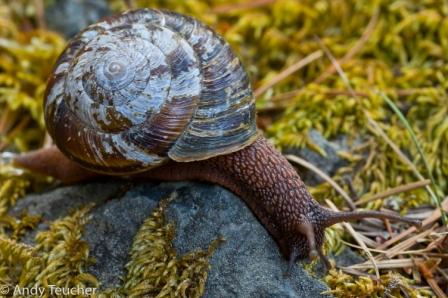
| Scientific Name: | Monadenia fidelis |
|---|---|
| English Name: | Pacific Sideband |
| Provincial Status Summary | |
| Status: | S4 |
| Date Status Assigned: | December 01, 2015 |
| Date Last Reviewed: | February 05, 2025 |
| Reasons: | This species has a limited range in BC, extending along the south coast up to the Broughton Archipelago. However, it is commonly encountered and well-documented in the areas where it occurs. It inhabits a diverse range of environments, including deciduous and mixed forests, as well as open woodlands and grassy areas. |
| Range | |
| Range Extent: | F = 20,000-200,000 square km |
| Range Extent Comments: | This species occurs over a range of approximately 65 000 km2 in south west BC, west of the Coast and Cascade mountains; Vancouver Island, Georgia Depression and in the Fraser Valley (Forsyth 2004; Forsyth 2014; Morgan 2014; Ovaska and Sopuck 2016; Ovaska et al. 2016; iNaturalist, accessed 31 October 2024; GBIF, accessed 31 October 2024). |
| Area of Occupancy (km2): | F = 126-500 |
| Occurrences & Population | |
| Number of Occurrences: | DE = 81 to >300 |
| Comments: | There are at least 260 known occurrences throughout the range (Forsyth 2014), with much suitable habitat. Due to their large size they are relatively well reported, however there are areas where surveys have not been done. There are over 2000 observations on iNaturalist (accessed 31 October 2024) and 2600 records in GBIF (accessed 31 October 2024). |
| Number of Occurrences with Good Viability / Ecological Integrity: | U = Unknown |
| Number of Occurrences Appropriately Protected & Managed: | Rank Factor not assessed |
| Population Size: | U = Unknown |
| Threats (to population, occurrences, or area affected) | |
| Degree of Threat: | U = Unknown |
| Comments: | Major threats include habitat loss and fragmentation due to human development, forestry and agricultural practices on the west coast and in the lower mainland (Brown and Durand 2007, Forsyth 2014). They have been found in protected or moderately disturbed areas, using a wide variety of habitats, including deciduous and mixed forests as well as in open woods and grassy areas. The threats have not been quantified. |
| Trend (in population, range, area occupied, and/or condition of occurrences) | |
| Short-Term Trend: | U = Unknown |
| Long-Term Trend: | U = Unknown |
| Other Factors | |
| Intrinsic Vulnerability: | U=Unknown |
| Environmental Specificity: | C=Moderate. Generalist or community with some key requirements scarce. |
| Comments: | Found in deciduous, coniferous or mixed forests but also in open woods and grassy areas; it has also been found in trees up to 22 ft (Jackson 1923, cited by Forsyth 2004). |
| Other Rank Considerations: | |
| Information Gaps | |
| Research Needs: | |
| Inventory Needs: | |
| Stewardship | |
| Protection: | |
| Management: | |
| Version | |
| Author: | L. Ramsay (2024), Forsyth, R. and L. Gelling (2015) |
| Date: | November 01, 2024 |
| References | |
|
Brown, D. and B.R. Durand. 2007. Habitat Assessment of the Pacific Sideband (Monadenia fidelis) In the Lower Fraser Valley British Columbia. Fraser Valley Conservancy Society. 17 pp.
|
|
|
Forsyth, R.G. 2000. The land snail Cryptomastix germana (Gastropoda: Polygyridae) in the Queen Charlotte Islands, British Columbia: a range extension north from Vancouver Island. The Canadian Field-Naturalist 114:316-317.
|
|
|
Forsyth, R.G. 2003a. Land snails of British Columbia. Online. Available: http://www3.telus.net/rforsyth/index.html (no longer available)
|
|
|
Forsyth, R.G. 2004. Land snails of British Columbia. University of British Columbia Press. Vancouver, BC. 176pp.
|
|
|
GBIF.org. 2024w. GBIF. Occurrence download for Monadenia fidelis. Accessed 31 October 2024.
|
|
|
iNaturalist community. 2024k. Observations of Monadenia fidelis from British Columbia, Canada. Exported from www.inaturalist.org on 31 October 2024.
|
|
|
Jackson, R.W. 1923. Epiphragmophora a tree climber. The Nautilus 36:144 (Article not seen, citation from Forsyth, R.G. 2004. Land snails of British Columbia. University of British Columbia Press. Vancouver. 176pp.)
|
|
|
Morgan, K. 2014. Gastropod surveys of Three Creeks 2014. Fraser Valley Conservancy. 14 pp.
|
|
|
Ovaska, K., L. Sopuck and C. Engelstoft. 2016. Distribution and Habitats of the Blue-grey Taildropper at Observatory Hill on Southern Vancouver Island Annual report: Year 3, April 2015 ? March 2016. Prepared for: National Research Council of Canada (unpublished). 27 pp.
|
|
Please visit the website Conservation Status Ranks for information on how the CDC determines conservation status ranks. For global conservation status reports and ranks, please visit the NatureServe website http://www.natureserve.org/.
Suggested Citation:
B.C. Conservation Data Centre. 2024. Conservation Status Report: Monadenia fidelis. B.C. Minist. of Environment. Available: https://a100.gov.bc.ca/pub/eswp/ (accessed Jun 8, 2026).