
BC Conservation Data Centre: Species Summary
Aquila chrysaetos
Golden Eagle
| Scientific Name: | Aquila chrysaetos (Linnaeus, 1758) | ||||||||||
|---|---|---|---|---|---|---|---|---|---|---|---|
| English Name: | Golden Eagle | ||||||||||
| Classification / Taxonomy | |||||||||||
| Scientific Name - Concept Reference: | American Ornithologists' Union (AOU). 1998. Check-list of North American birds. Seventh edition. American Ornithologists' Union, Washington, D.C. [as modified by subsequent supplements and corrections published in The Auk]. Also available online: http://www.aou.org/. | ||||||||||
| Classification Level: | Species | ||||||||||
| Species Group: | Vertebrate Animal | ||||||||||
| Species Code: | B-GOEA | ||||||||||
|
|||||||||||
| Conservation Status / Legal Designation | |||||||||||
| Global Status: | G5 (Apr 2016) | ||||||||||
| Provincial Status: | S4S5 (Mar 2015) | ||||||||||
| BC List: | Yellow | ||||||||||
| Provincial FRPA list: | |||||||||||
| Provincial Wildlife Act: | |||||||||||
| COSEWIC Status: | Not at Risk (May 1996) | ||||||||||
| SARA Schedule: | |||||||||||
| General Status Canada: | 4 - Secure (2005) | ||||||||||
| Migratory Bird Convention Act: | |||||||||||
| Ecology & Life History | |||||||||||
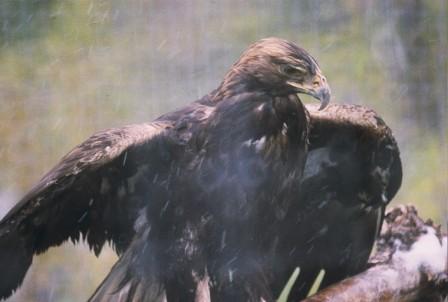
| General Description: | This is a very large raptor with mostly brown plumage, a golden wash on the back of the head and neck, and a mostly horn-colored bill; tail is faintly banded; immatures have white at the base of the primaries and a white tail with a dark terminal band; total length 76-102 cm, wingspan 203-224 cm (NGS 1983). | ||||||||||
| Global Reproduction Comments: | Egg dates: by late April in northern Alaska (later if snow persists); peak in late February-March in the region from California to Texas (but earlier nesting may yield young ready to fly as early as March 1 in Texas); late February-early March in Utah; March-April in northeastern United States. Clutch size is 1-3, rarely 4 (usually 2). Incubation, mostly by the female, lasts about 43-45 days. Young can fly at 60-77 days (fledging takes longer in the far north than in the southern part of the range). Young are cared for by parents for 30+ additional days; family unit sometimes may remain together several months. Typically first breeds in 4th or 5th year. Lifelong monogamy may be the rule, though some apparent exceptions have been recorded. A positive correlation between breeding success and jackrabbit number was reported in Idaho, Colorado, and Utah. Distance between active nests almost never is less than 0.8 km. See Palmer (1988) for further details on reproduction. | ||||||||||
| Migration Characteristics: (Global / Provincial) | |||||||||||
|
Nonmigrant: Local Migrant: Distant Migrant: Within Borders Migrant: |
Y / Y / Y / na / |
||||||||||
| Global Migration Comments: | Migratory populations may exist in areas where the species is present throughout the year, so specific migration patterns may be obscure. Northernmost populations withdraw southward for winter (some individuals may remain in north); these migrants may migrate farther south than do birds from breeding populations to the south; migrants return to northern breeding areas mainly in March-April. Most vacate hot deserts during summer. In predatory bird surveys over 12 months in the eastern Mohave Desert, San Bernardino County, California, Knight et al. (1999) observed golden eagles only during November and December, despite the species being a regular nesting bird in the Mohave Desert. The low number of observations may have reflected a naturally low density of eagles, lack of overlap of survey routes with eagle territories, or seasonal migrations of eagles between summer nesting areas in desert mountains and wintering areas in desert basins (Knight et al. 1999). See Palmer (1988) for discussion of seasonal movements. A juvenile from Denali National Park, Alaska, migrated through Yukon Territory and interior British Columbia to a wintering site in east-central Idaho; another juvenile migrated through the Yukon, Alberta, and Saskatchewan to northeastern Montana (Britten et al. 1995). Territory size in several areas of the western United States averaged 57-142 sq km (Palmer 1988). In desert regions, territories may be much larger (e.g., 258-310 sq km; see Wildlife Research Institute 2010). |
||||||||||
| Habitats: (Type / Subtype / Dependence) |
Agriculture / Cultivated Field / Unknown
Agriculture / Hedgerow / Unknown Agriculture / Pasture/Old Field / Unknown Alpine/Tundra / Alpine Grassland / Unknown Alpine/Tundra / Alpine/Subalpine Meadow / Unknown Alpine/Tundra / Krummholtz / Unknown Anthropogenic / Urban/Suburban / Unknown Forest / Conifer Forest - Dry / Unknown Forest / Conifer Forest - Mesic (average) / Unknown Forest / Conifer Forest - Moist/wet / Unknown Forest / Deciduous/Broadleaf Forest / Unknown Grassland/Shrub / Grassland / Unknown Grassland/Shrub / Meadow / Unknown Grassland/Shrub / Sagebrush Steppe / Unknown Grassland/Shrub / Shrub - Natural / Unknown Other Unique Habitats / Avalanche Track / Unknown Riparian / Riparian Forest / Unknown Rock/Sparsely Vegetated Rock / Cliff / Unknown Rock/Sparsely Vegetated Rock / Rock/Sparsely Vegetated Rock / Unknown Rock/Sparsely Vegetated Rock / Talus / Unknown Wetland / Bog / Unknown Wetland / Fen / Unknown Wetland / Marsh / Unknown Wetland / Swamp / Unknown |
||||||||||
| Global Habitat Comments: |
Golden eagles generally inhabit open and semi-open country such as prairies, sagebrush, arctic and alpine tundra, savannah or sparse woodland, and barren areas, especially in hilly or mountainous regions, in areas with sufficient mammalian prey base and near suitable nesting sites. In Nevada, the only habitats routinely avoided by golden eagles are forests, large agricultural areas, and urban areas (GBBO 2010). Nests are most often on rock ledges of cliffs but sometimes in large trees (e.g., oak or eucalytus in California, white pine in eastern North America), on steep hillsides, or on the ground. Nesting cliffs may face any direction and may be close to or distant from water. In Elko County, Nevada, 93 percent of nests were on cliffs, 71 percent were at elevations between 5,000 feet and 6,500 feet, and 43 percent faced east; 84 percent of nests were within two miles of water with desert riparian habitat (Page and Seibert 1973). A pair may have multiple alternate nests; the pair may use the same or alternate nests in consecutive years. |
||||||||||
| Food Habits: |
Carnivore: Adult, Immature
|
||||||||||
| Global Food Habits Comments: | The diet consists promarily of small mammals (e.g., rabbits, marmots, ground squirrels) but sometimes also includes large insects, snakes, birds, juvenile ungulates, and carrion. In the western Great Basin, the four most frequent prey species were black-tailed jackrabbit, mountain cottontail, yellow-bellied marmot, and chukar; Lagomorpha accounted for 91 percent of the prey biomass (Bloom and Hawks 1982). Golden eagles rarely attack large, healthy mammals (e.g., pigs, sheep, deer) (Terres 1980). Individual can fast for days between feedings. They hunt while soaring or from a perch (the latter especially used by young), and individuals may hunt cooperatively. See Palmer (1988) for further details. | ||||||||||
| Global Phenology: |
Diurnal: Adult, Immature
|
||||||||||
| Global Phenology Comments: | Foraging commonly occurs in early morning and early evening. | ||||||||||
| Provincial Phenology: (1st half of month/ 2nd half of month) |
|||||||||||
| Colonial Breeder: | N | ||||||||||
| Length(cm)/width(cm)/Weight(g): | 102/ / 4692 | ||||||||||
| Elevation (m) (min / max): |
Global:
Provincial: |
||||||||||
| Distribution | |||||||||||
| Endemic: | N | ||||||||||
| Global Range Comment: | In North America, breeding occurs from western and northern Alaska eastward through Northwest Territories to Labrador, and south to northern Mexico, Texas, western Oklahoma, and western Kansas, and in eastern North America southward to New York and northern New England (rare). See Lee and Spofford (1990) for a review of nesting records from the central and southern Appalachians (most nesting records south of the Adirondacks are doubtful). Golden eagles breed also in the Palearctic. The winter range in North America extends from south-central Alaska and southern Canada southward through the breeding range, and casually farther southward. In the United States, the species is most numerous in winter in the Rocky Mountain states, Great Basin, and western edge of the Great Plains (Root 1988). See Milsap and Vana (1984) for information on winter range in the eastern United States. Northernmost populations in Eurasia winter south to northern Africa (Sibley and Monroe 1990). | ||||||||||
| Authors / Contributors | |||||||||||
| Global Information Author: | Hammerson, G. | ||||||||||
| Last Updated: | Aug 16, 2011 | ||||||||||
| Provincial Information Author: | |||||||||||
| Last Updated: | |||||||||||
| References and Related Literature | |||||||||||
American Ornithologists' Union (AOU). 1983. Check-list of North American Birds, 6th edition. Allen Press, Inc., Lawrence, Kansas. 877 pp. |
|||||||||||
Bates, J. W., and M. O. Moretti. 1994. Golden eagle (AQUILA CHRYSAETOS) population ecology in eastern Utah. Great Basin Nat. 54:248-255. |
|||||||||||
Bednarz, J. C., D. Klem Jr., L. J. Goodrich, and S. E. Senner. 1990. Migration counts of raptors at Hawk Mountain, Pennsylvania, as indicators of population trends, 1934-1986. The Auk 107:96-109. |
|||||||||||
Beecham, J. J., and M. N. Kochert. 1975. Breeding biology of the golden eagle in southwestern Idaho. Wilson Bulletin 87:506-513. |
|||||||||||
Biosystems Analysis, Inc. 1989. Endangered Species Alert Program Manual: Species Accounts and Procedures. Southern California Edison Environmental Affairs Division. |
|||||||||||
Britten, M. W., C. L. McIntyre, and M. Kralovec. Satellite radiotelemetry and bird studies in national parks and preserves. Park Science 15(2):20-24. |
|||||||||||
Campbell, R.W., N.K. Dawe, I. McTaggart-Cowan, et al. 1990b. The Birds of British Columbia Vol. 2: Nonpasserines: Diurnal Birds of Prey through Woodpeckers. Royal British Columbia Museum, Victoria, BC. |
|||||||||||
Dixon, J. B. 1937. The golden eagle in San Diego County, California. Condor 39:49-56. |
|||||||||||
Ehrlich, P. R., D. S. Dobkin, and D. Wheye. 1992. Birds in Jeopardy: the Imperiled and Extinct Birds of the United States and Canada, Including Hawaii and Puerto Rico. Stanford University Press, Stanford, California. 259 pp. |
|||||||||||
Fala et al. 1985. Raptor Res. 19:1-7. |
|||||||||||
Fisher, A.K. 1893. The hawks and owls of the United States in their relation to agriculture. Washington U.S. Dept. of Agriculture Bull. no. 6. 210 pp. |
|||||||||||
Harrison, C. 1978. A Field Guide to the Nests, Eggs and Nestlings of North American Birds. Collins, Cleveland, Ohio. |
|||||||||||
Johnsgard, P. A. 1990. Hawks, eagles, and falcons of North America. Smithsonian Inst. Press, Washington, D.C. xvi + 403 pp. |
|||||||||||
Johnson, S. R. and D. R. Herter. 1989. The Birds of the Beaufort Sea. BP Exploration (Alaska) Inc., Anchorage, Alaska. 372 pp. |
|||||||||||
Kirk, D. A., D. Hussell, and E. Dunn. 1995. Raptor population status and trends in Canada. Bird Trends (Canadian Wildlife Service) 4:2-9. |
|||||||||||
Lee, D. S., and W. R. Spofford. 1990. Nesting of golden eagles in the central and southern Appalachians. Wilson Bull. 102:693-698. |
|||||||||||
LeFranc, M. N., Jr., and W. S. Clark. 1983. Working bibliography of the golden eagle and the genus AQUILA. National Wildife Federation Scientific & Technical Series No. 7, Washington, D.C. xxx + 222 + 12 appendix pp. |
|||||||||||
McGahan, J. 1968. Ecology of the golden eagle. Auk 85:1-12. |
|||||||||||
Milsap, B. A., and S. L. Vana. 1984. Distribution of wintering golden eagles in the eastern United States. Wilson Bull. 96:692-701. |
|||||||||||
Murphy, R. 1965. The golden eagle. N.Y. 157 pp. |
|||||||||||
National Geographic Society (NGS). 1983. Field guide to the birds of North America. National Geographic Society, Washington, DC. |
|||||||||||
Palmer, R. S., ed. 1988b. Handbook of North American birds. Vol. 5. Yale Univ. Press, New Haven. 465 pp. |
|||||||||||
Pendleton, B. A. G., B. A. Millsap, K. W. Cline, and D. M. Bird. 1987. Raptor management techniques manual. National Wildlife Federation, Sci. and Tech. Ser. No. 10. 420 pp. |
|||||||||||
Phillips, R. L., J. L. Cummings, and J. D. Berry. 1991. Responses of breeding golden eagles to relocation. Wildl. Soc. Bull. 19:430-434. |
|||||||||||
Root, T. 1988. Atlas of wintering North American birds: An analysis of Christmas Bird Count data. University of Chicago Press. 336 pp. |
|||||||||||
Sibley, C.G., and B.L. Monroe, Jr. 1990. Distribution and Taxonomy of Birds of the World. Yale University Press, New Haven, CT. xxiv + 1111 pp. |
|||||||||||
Smith, D. G., and J. R. Murphy. 1973. Breeding ecology of raptors in the eastern Great Basin of Utah. Brigham Young University Science Bulletin, Biol. Ser. 13:1-76. |
|||||||||||
Snow, C. 1973. Habitat management series for unique or endangered species, Report No. 7, Golden Eagle, AQUILA CHRYSAETOS. Bureau of Land Management, U.S. Dept. of Int., Technical Note, T-N-239, Denver. |
|||||||||||
Spofford, W.R. 1971. THE BREEDING STATUS OF THE GOLDEN EAGLEIN THE APPALACHIANS. AMERICAN BIRDS 25(1):3-7. |
|||||||||||
Terres, J. K. 1980. The Audubon Society encyclopedia of North American birds. Alfred A. Knopf, New York. |
|||||||||||
Please visit the website Conservation Status Ranks for definitions of the data fields used in this summary report.
Suggested Citation:
B.C. Conservation Data Centre. 2011. Species Summary: Aquila chrysaetos. B.C. Minist. of Environment. Available: https://a100.gov.bc.ca/pub/eswp/ (accessed Jun 7, 2026).