
BC Conservation Data Centre: Species Summary
Bartramia longicauda
Upland Sandpiper
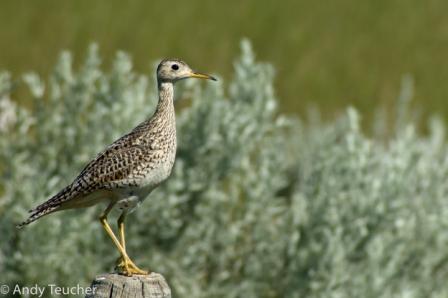
| Scientific Name: | Bartramia longicauda (Bechstein, 1812) | ||||||||||
|---|---|---|---|---|---|---|---|---|---|---|---|
| English Name: | Upland Sandpiper | ||||||||||
| Classification / Taxonomy | |||||||||||
| Scientific Name - Concept Reference: | American Ornithologists' Union (AOU). 1998. Check-list of North American birds. Seventh edition. American Ornithologists' Union, Washington, D.C. [as modified by subsequent supplements and corrections published in The Auk]. Also available online: http://www.aou.org/. | ||||||||||
| Classification Level: | Species | ||||||||||
| Species Group: | Vertebrate Animal | ||||||||||
| Species Code: | B-UPSA | ||||||||||
|
|||||||||||
| Conservation Status / Legal Designation | |||||||||||
| Global Status: | G5 (Apr 2016) | ||||||||||
| Provincial Status: | S2B (Mar 2022) | ||||||||||
| BC List: | Red | ||||||||||
| Provincial FRPA list: | |||||||||||
| Provincial Wildlife Act: | |||||||||||
| COSEWIC Status: | |||||||||||
| SARA Schedule: | |||||||||||
| General Status Canada: | 4 - Secure (2005) | ||||||||||
| Migratory Bird Convention Act: | Y | ||||||||||
| Ecology & Life History | |||||||||||
| General Description: | Ranges from 27.9-32.5 cm in size and is the most terrestrial of North American shorebirds. The sexes are outwardly alike; females average slightly larger than males (Forbush 1925, Prater et al. 1977). Breeding adults are overall scaly-brown in appearance above with a long slender neck, small rounded head, and relatively long tail. The upper neck is buff-streaked brown with sharply defined V-shaped markings becoming more barred on the lower breast and flanks. The throat and abdomen are white. The eye is large with a dark iris. The bill is short, slightly decurved and dusky at the tip. The tail feathers are barred, dark brown with outer tertials pale orange-brown basally, tipped with white. Legs and feet are yellow-grey (Forbush 1925, Roberts 1955, Prater et al. 1977). Adults captured at the nest may be sexed by wing chord and tail length. This method of sex determination is estimated to be 88.3% accurate for mated pairs (Peterson 1983). Downy young are a fine, mixed pattern of black, white and buff yellowish-brown above. A black stripe runs from the base of the bill over the top of the head. There is a band of buff or yellowish-brown across the upper breast. The sides of the head, chin and underparts are generally white (Forbush 1925). Juveniles resemble adults, but the upperparts are darker and scalier with the buffy color of the neck, breast and wings much deeper and the streaks of the foreneck and breast less distinct. The wing coverts have clear buffy edges and dark submarginal lines. The scapulars are uniformly dark with narrow, defined buff-white fringes. The tail feathers are notched with pale buff. Following the first prenuptial molt the young become indistinguishable from adults (Forbush 1925, Hayman et al. 1986). Winter plumage is similar to that of the breeding adult, but paler (Forbush 1925). VOCALIZATIONS: The unique vocalizations include a rapid, liquid "quip-ip-ip-ip" series of alarm notes and a penetrating "whip-whee-ee-you" windy whistle (Johnsgard 1981). NESTS: The nest is a shallow depression in the ground approximately 10-13 cm in diameter and five cm deep, lined with pieces of dry grass (Bent 1929). Nests are usually well hidden, frequently by vegetation that hangs over the nest hiding it from above (Johnsgard 1981). The eggs are cinnamon to pale olive-buff or greenish-white in color, spotted with brown and underlaying spots of ecru or pale grey. Clutch size is normally four eggs, sometimes three, and rarely five (Bent 1929). |
||||||||||
| Global Reproduction Comments: |
Courtship is exhibited in spectacular soaring displays while ascending in great circles high into the sky accompanied by a long, drawn-out "whip-whee-ee-you" whistle, and in low over-the-ground flight on stiff, quivering wings (Buss and Hawkins 1939). On the ground, the male will sometimes approach the female, raising his tail and running towards her while giving a short, guttural whistle (Ailes 1976). This pre-copulatory behavior is sometimes followed by mating. Initial nesting activity, which is thought to be somewhat synchronous (Higgins and Kirsch 1975), begins two to three weeks after spring arrival in breeding areas, from mid-April to early May (Forbush 1925, Buss and Hawkins 1939, Ailes 1980). The maximum period between the earliest initiated nests and the latest hatched nests in North Dakota (Higgins and Kirsch 1975), Wisconsin (Ailes 1980), and Massachusetts (White and Melvin 1985) ranged from eight to ten weeks. Some late nesting, or renesting, due to early nest failure may occur (Ailes 1980). Clutch size is normally four eggs, sometimes three, and rarely five (Bent 1929). Eggs layed mostly May-June (late April to early June in Virginia). Incubate eggs an average of 24 days (Higgins and Kirsch 1975), with extremes of 21-28 days reported by some investigators (Johnsgard 1981). Both sexes incubate. Chicks are precocial and leave the nest within 24 hours after hatching (Ailes 1980). Broods are tended by one (Ailes 1980) or both adults (Buss 1951) until the young attain adult weight and are capable of flight at 30-34 days (Buss and Hawkins 1939, Ailes 1980). Ailes (1980) reported that adults with young in Wisconsin utilized brood-rearing fields within a short distance of the nesting site for several weeks following hatching. In contrast, Buss (1951) found that adults with young in the Yukon Territory required a large home range, up to 3.2 km in diameter. Family groups tend to stay together at least until postbreeding migration. Estimates of nesting success in Northern Plains states range from 63% (Lindmeier 1960) to 100% (Lokemoen and Duebbert 1974). Using the Mayfield (1961) method to determine seasonal nest success rates, Buhnerkempe and Westemeier (1988) calculated nest success in Jasper County, Illinois to be 48%. The time elapsed between arrival and departure from breeding areas has been observed to be as brief as 100 days (Higgins and Kirsch 1975) and as long as 165 days (Buss and Hawkins 1939). Higgins and Kirsch (1975) correlated the average, frost-free period with dates of first nest initiation and final departure from breeding areas in North Dakota and Wisconsin, and suggested that some breeding ground activities may be directly or indirectly related to temperature at northern latitudes. Buss (1951) correlated the timing of fall migration in the Yukon with decreasing numbers of available insects. Data obtained from marked birds in Kansas suggest that upland sandpipers first breed when they are one year old (D. Bowen, pers. comm.). The natural longevity is not known. The longest known survival of a banded bird is five years (Clapp et al. 1982). | ||||||||||
| Global Ecology Comments: |
Tend to be loosely colonial while breeding (Bowen 1976), often occupying the same nesting fields in successive years (Buss and Hawkins 1939, Ailes 1980). Density varies from 0.6-6.1 ha/nest in loosely spaced "colonies" (Harrison 1979). Nest territories are generally grouped and consist of a nesting site, plus a loafing and feeding area near or adjacent to the nest territory which is shared communally (Buss and Hawkins 1939). In the central portion of the range in North Dakota, breeding densities of up to 20 pairs/mi squared (2.59/km squared) have been recorded (Stewart and Kantrud 1972). Limited studies on home ranges of breeding birds; in Wisconsin, one female occupied 85.6 hectares and one male occupied only 8.5 hectares (Ailes and Toepfer 1977). Studies by Bowen (1976) and Ailes (1980) suggest that adults may exhibit some degree of site faithfulness, although Ailes (1980) found that none of the 61 young he banded returned to their natal grounds the following year. In nonbreeding season, solitary or in small scattered groups. |
||||||||||
| Migration Characteristics: (Global / Provincial) | |||||||||||
|
Nonmigrant: Local Migrant: Distant Migrant: Within Borders Migrant: |
N / N / Y / na / |
||||||||||
| Global Migration Comments: | Arrives in northern breeding areas in April-May, departs by September (Bent 1929). Peak spring migration through the U.S. mid-Atlantic states occurs in April. Rare spring and fall migrant in Puerto Rico (Raffaele 1983). | ||||||||||
| Habitats: (Type / Subtype / Dependence) |
Agriculture / Cultivated Field / Facultative - frequent use
Agriculture / Hedgerow / Facultative - frequent use Agriculture / Pasture/Old Field / Facultative - frequent use Anthropogenic / Urban/Suburban / Facultative - occasional use Grassland/Shrub / Grassland / Facultative - frequent use Grassland/Shrub / Meadow / Facultative - frequent use Ocean / Intertidal Marine / Facultative - occasional use |
||||||||||
| Global Habitat Comments: |
BREEDING: Restricted primarily to extensive, open tracts of short grassland habitat. Nest in native prairie, dry meadows, pastures, domestic hayfields, short-grass savanna, plowed fields, along highway rights-of-way and on airfields, and (in the north) peatlands and scattered woodlands near timberline (Forbush 1925, Higgins et al. 1969, AOU 1983, Osborne and Peterson 1984, Godfrey 1986). Nesting is also known to occur in dry patches of wet meadows (Stewart 1975, Herman et al. 1984) and in blueberry (VACCINIUM spp.) barrens (J. Albright, pers. comm.). A survey of nesting habitats in Wisconsin (White 1983) suggests that upland sandpipers favor a level topography with a minimum of tall vegetation edges and proportionately high acreages of agricultural crops which duplicate prairie grasslands in terms of structure. Preferred habitat includes large areas of short grass for feeding and courtship with interspersed or adjacent taller grasses for nesting and brood cover; in the northeastern U.S., airfields currently provide the majority of suitable habitat, though grazed pastures and grassy fields also are used (Carter 1992). Nests on ground among grasses; sometimes along prairie sloughs (Terres 1980). The quality of a particular habitat is best indicated by the total number of birds present during May and June. Observations by Buss and Hawkins (1939) suggest a delicate distinction between acceptable and unacceptable sites. A slight change in an accepted field may cause it to become unacceptable, i.e., heavy or early grazing, standing water, burning, and manuring may reduce or exclude nesting from fields accepted the previous year. Abandoned fields with invading shrubs and trees may sometimes exclude upland sandpipers (Laughlin and Kibbe 1985), although at a site in Massachusetts, they nest in fields with scattered shrubs and one to two m tall pine trees (PINUS spp.) (White and Melvin 1985). Airports and airfields offer excellent habitat for breeding colonies, providing level expanses of short grass fields attractive to upland sandpipers. Nesting surveys in the mid-1980s in Ohio (Osborne and Peterson 1984) and in Massachusetts (White and Melvin 1985) showed that airport habitats in these states were utilized over all other habitats with respect to the number of sites and number of individuals per site. The short grassy strips along runways and taxiways are used for feeding, loafing, nesting, brood-rearing and pre-migratory flocking. Upland sandpipers are believed to pose little threat to aircraft at airports because of their small size, typical behavioral patterns, and tendency to remain mostly on the ground. Flight is usually low and direct (White and Melvin 1985). Vegetation height is an important factor in the selection of nesting sites (Kirsch and Higgins 1976). Nesting studies by Ailes (1980) in Wisconsin recorded 54% of nests in cover between 25-40 cm in height, not exceeding 70 cm at the time of egg hatching. In North Dakota nesters were found in cover between 15.5-30.8 cm in height, and appeared to avoid cover over 61.5 cm (Kirsch and Higgins 1976). White and Melvin (1985) reported that vegetation surrounding six active nests located on a Massachusetts airfield ranged from 8.0-25.0 cm in height. Agricultural land use patterns and farming practices influence the choice of nesting sites. In central Wisconsin, Ailes (1980) found that idle fields and hayfields accounted for the majority of nesting habitats. Nesting studies in North and South Dakota indicated the majority of nests were in ungrazed grasslands of medium density with abundant ground litter (Higgins et al. 1969). A five-year survey (1969-74) of intensively cultivated areas in the prairie pothole region of east-central North Dakota recorded 57% of nests in untilled habitats, which comprised only 7% of the total study area (Higgins 1975). In Illinois, Buhnerkempe and Westemeir (1988) reported that sandpipers selected stands of grass and forbs for nesting and avoided fields of uniform grass and legumes. In North Dakota, Kirsch and Higgins (1976) recorded their lowest mean nest densities in annually tilled croplands and their highest mean nest densities in native grasslands the second season after a prescribed burn. Seeded grass/legume mixtures generally grew too tall and dense. Kirsch and Higgins (1976) found that the majority of North Dakota nests were located in either thin, uniform vegetative cover or in scattered clumps of fairly dense cover characterized by standing stubble fields, moderately grazed pastures, mowed areas with heavy regrowth, brush clumps with some understory vegetation, and undisturbed vegetation on poor soils. Residual vegetation from the previous growing seasons accounted for 25% of the cover at 54% of sandpiper nests. Upland sandpipers use grassy fields of low vegetation height for feeding and brood rearing. Ailes (1980) observed 66% of adults with young in Wisconsin in grazed pastures, 13% in ungrazed pastures, and 11% in hayfields. Ailes (1980) found a large percentage of adults with young in Wisconsin in heavily grazed fields with vegetation ranging from zero to ten cm in height. Buhnerkempe and Westemeir (1988) reported that, in Illinois, they selected brood habitats of wheat stubble fields, recently hayed legumes, old redtop meadows (AGROSTIS spp.), and moderately grazed pastures. A South Dakota grasslands management study showed habitat use (nesting was not documented) to be highest in recently burned fields with short, open, new growth and no litter or old growth (Huber and Steuter 1984). Upland sandpipers accept a variety of native and introduced grasses (Buss and Hawkins 1939). Timothy (PHLEUM spp.), bluegrass (POA spp.), needlegrass (STIPA spp.), bluestem (ANDROPOGON spp.), quackgrass (AGROPYRON spp.), Junegrass (KOELERA spp.), and bromegrass (BROMUS spp.) are among the grasses associated with nesting fields (Buss and Hawkins 1939, Meanley 1943, Buss 1951, Higgins et al. 1969, Kirsch and Higgins 1976, Ailes 1980). NON-BREEDING: Very rarely in migration along shores and mudflats (AOU 1983). On wintering grounds in South America, have been observed in pastures of remote estancias (Wetmore 1927), harvested and burnt-over canefields, football fields, airfields (Haverschmidt 1966), and on sandy beaches where the vegetation is open or recently burned (Spanns 1978). Changes in land use and agricultural practices may be critical to the limited numbers (White 1988). In the province of Cordoba, Argentina, where the greatest numbers have been reported to date, native espinal (scrub trees) have been converted to dairy farms planted in pasture and alfalfa. Upland sandpipers possibly prefer the drier climate and planted grasses to historically utilized wetter, native grasslands found farther south and southeast (White 1988). |
||||||||||
| Food Habits: |
Invertivore: Adult, Immature
|
||||||||||
| Global Food Habits Comments: | Feed almost exclusively on insects, especially grasshoppers and crickets (Orthoptera), weevils (Coleoptera), and other small invertebrates gathered from or close to the ground (Terres 1980). Occasional seeds of weeds, grasses and waste grains, including wheat, are also consumed (McAtee and Beal 1912, Forbush 1925, Ehrlich et al. 1992). Obtains food from ground. | ||||||||||
| Global Phenology: |
Circadian: Adult, Immature
|
||||||||||
| Provincial Phenology: (1st half of month/ 2nd half of month) |
|||||||||||
| Colonial Breeder: | N | ||||||||||
| Length(cm)/width(cm)/Weight(g): | 31/ / 190 | ||||||||||
| Elevation (m) (min / max): |
Global:
Provincial: |
||||||||||
| Distribution | |||||||||||
| Endemic: | N | ||||||||||
| Global Range Comment: | BREEDING: Contiguous portion of breeding range extends from southern Alberta east of Rocky Mountains; across southern Canada to southern Ontario (isolated populations in Thunder Bay and Rainy River areas) and southern Quebec (isolated populations in Lake St.-Jean lowlands and in Abitibi region); south to Montana, northeastern Colorado, northern Oklahoma, western Missouri, Illinois, Indiana, Pennsylvania, central New York, and Vermont. Also extends south through portions of Maryland to extreme northern Virginia and the mountains of West Virginia, and is spottily distributed along Atlantic Coast from Canadian Maritime Provinces south to Delaware. Largely absent from central south Michigan, northeastern Indiana, and northwestern Ohio, and from portions of north and east Pennsylvania, southeastern New York, and the Adirondack Mountains. Disjunct populations in the west: north-central Alaska, Yukon, southwestern Northwest Territories, northeastern British Columbia, Oregon, and western Idaho (summarized in Houston and Bowen 2001). NON-BREEDING: South America east of Andes, from Suriname and northern Brazil south to central Argentina and Uruguay (AOU 1983, Houston and Bowen 2001); the largest concentrations occur in Argentina and Uruguay (White 1988). Casual or accidental in Greenland, Iceland, the British Isles and continental Europe, Azores, and Australia (Houston and Bowen 2001). |
||||||||||
| Authors / Contributors | |||||||||||
| Global Information Author: | Hammerson, G. | ||||||||||
| Last Updated: | Feb 14, 1995 | ||||||||||
| Provincial Information Author: | |||||||||||
| Last Updated: | |||||||||||
| References and Related Literature | |||||||||||
American Ornithologists' Union (AOU). 1983. Check-list of North American Birds, 6th edition. Allen Press, Inc., Lawrence, Kansas. 877 pp. |
|||||||||||
Bent, A.C. 1929. Life histories of North American shorebirds (Part II). U.S. Natl. Mus. Bull. 146. Washington, D.C. |
|||||||||||
Byrd, M. A., and D. W. Johnston. 1991. Birds. Pages 477-537 in K. Terwilliger, coordinator. Virginia's endangered species: proceedings of a symposium. McDonald and Woodward Publ. Co., Blacksburg, Virginia. |
|||||||||||
Campbell, R.W., N.K. Dawe, I. McTaggart-Cowan, et al. 1990b. The Birds of British Columbia Vol. 2: Nonpasserines: Diurnal Birds of Prey through Woodpeckers. Royal British Columbia Museum, Victoria, BC. |
|||||||||||
Carter, J. W. 1992. Upland sandpiper, BARTRAMIA LONGICAUDA. Pages 235-252 in K. J. Schneider and D. M. Pence, editors. Migratory nongame birds of management concern in the Northeast. U.S. Fish and Wildlife Service, Newton Corner, Massachusetts. 400 pp. |
|||||||||||
Droege, S., and J.R. Sauer. 1990. North American Breeding Bird Survey, annual summary, 1989. U.S. Fish and Wildlife Service, Biological Report 90(8). 22 pp. |
|||||||||||
Ehrlich, P. R., D. S. Dobkin, and D. Wheye. 1992. Birds in Jeopardy: the Imperiled and Extinct Birds of the United States and Canada, Including Hawaii and Puerto Rico. Stanford University Press, Stanford, California. 259 pp. |
|||||||||||
Godfrey, W. E. 1986. The birds of Canada. Revised edition. National Museum of Natural Sciences, Ottawa. 596 pp. + plates. |
|||||||||||
Hagan, J. M., III, and D. W. Johnston, editors. 1992. Ecology and conservation of neotropical migrant landbirds. Smithsonian Institution Press, Washington, D.C. xiii + 609 pp. |
|||||||||||
Harrison, H. H. 1979. A field guide to western birds' nests. Houghton Mifflin Company, Boston. 279 pp. |
|||||||||||
Herkert, J. R., editor. 1992. Endangered and threatened species of Illinois: status and distribution. Vol. 2: Animals. Illinois Endangered Species Protection Board. iv + 142 pp. |
|||||||||||
Hooper, T.D. 1997. Status of the Upland Sandpiper in the Chilcotin-Cariboo Region, British Columbia. B.C. Minist. Environ., Lands and Parks, Wildl. Branch. Working rep. WR-86. 26pp. |
|||||||||||
Morrison, R. I. G., R. E. Gill, Jr., B. A. Harrington, S. Skagen, G. W. Page, C. L. Gratto-Trevor, and S. M. Haig. 2001. Estimates of shorebird populations in North America. Occasional Paper Number 104, Canadian Wildlife Service, Environment Canada, Ottawa, ON. 64 pages. |
|||||||||||
Peterjohn, B. G., J. R. Sauer, and W. A. Link. 1994. The 1992 and 1993 summary of the North American Breeding Bird Survey. Bird Populations 2:46-61. |
|||||||||||
Raffaele, H. A. 1983a. A guide to the birds of Puerto Rico and the Virgin Islands. Fondo Educativo Interamericano, San Juan, Puerto Rico. 255 pp. |
|||||||||||
Sauer, J.R., and S. Droege. 1992. Geographical patterns in population trends of Neotropical migrants in North America. Pages 26-42 in J.M. Hagan, III, and D.W. Johnston, editors. Ecology and conservation of Neotropical migrant landbirds. Smithsonian Institution Press, Washington, DC. |
|||||||||||
Stiles, F. G. and A. F. Skutch. 1989. A guide to the birds of Costa Rica. Cornell University Press, Ithaca, New York, USA. 511 pp. |
|||||||||||
Terres, J. K. 1980. The Audubon Society encyclopedia of North American birds. Alfred A. Knopf, New York. |
|||||||||||
U.S. Fish and Wildlife Service (USFWS). 1987. Migratory nongame birds of management concern in the United States: the 1987 list. U.S. Fish and Wildlife Service, Office of Migratory Bird Management, Washington, D.C. 63 pp. |
|||||||||||
White, R.P. 1983. Distribution and habitat preferences of the upland sandpiper. (Bartramia longicauda) in Wisconsin. Amer. Birds, 37 (1): 16-22. |
|||||||||||
Please visit the website Conservation Status Ranks for definitions of the data fields used in this summary report.
Suggested Citation:
B.C. Conservation Data Centre. 1995. Species Summary: Bartramia longicauda. B.C. Minist. of Environment. Available: https://a100.gov.bc.ca/pub/eswp/ (accessed Oct 3, 2026).