
BC Conservation Data Centre: Species Summary
Pseudacris regilla
Pacific Treefrog
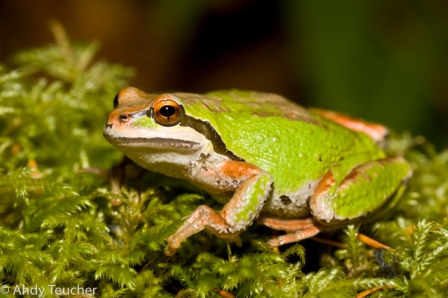
| Scientific Name: | Pseudacris regilla (Baird and Girard, 1852) | ||||||||||
|---|---|---|---|---|---|---|---|---|---|---|---|
| English Name: | Pacific Treefrog | ||||||||||
| English Name Synonyms: |
Northern Pacific Treefrog
Pacific Chorus Frog Pacific Treefrog |
||||||||||
| Classification / Taxonomy | |||||||||||
| Scientific Name - Concept Reference: | Recuero, E., I. Martínez-Solano, G. Parra-Olea, and M. García-París. 2006a. Phylogeography of Pseudacris regilla (Anura: Hylida) in western North America, with a proposal for a new taxonomic rearrangement. Molecular Phylogenetics and Evolution 39:293-304. [Taxonomic errors in this publication were corrected by Recuero, Martínez-Solano, Parra-Olea, and García-París. 2006. Molecular Phylogenetics and Evolution 41:511.] | ||||||||||
| Classification Level: | Species | ||||||||||
| Species Group: | Vertebrate Animal | ||||||||||
| Species Code: | A-PSRE | ||||||||||
|
|||||||||||
| Conservation Status / Legal Designation | |||||||||||
| Global Status: | G5 (Aug 2016) | ||||||||||
| Provincial Status: | S5 (Mar 2023) | ||||||||||
| BC List: | Yellow | ||||||||||
| Provincial FRPA list: | |||||||||||
| Provincial Wildlife Act: | |||||||||||
| COSEWIC Status: | |||||||||||
| SARA Schedule: | |||||||||||
| General Status Canada: | 4 - Secure (2005) | ||||||||||
| Ecology & Life History | |||||||||||
| General Description: | Dorsal color highly variable: usually green or brown, but also gray, tan, bronze, blackish, or reddish, often with irregular dark spots or blotches ; toe tips expanded; dark stripe from snout to shoulder; snout-vent length up to about 5 cm. Mature male: dark throat; breeding call is a loud repeated kreck-ek. Larvae: brown or olive, often with spotting or mottling; eyes wide apart, at margin of head when viewed from above; to about 44 mm long. Egg masses: soft loose clumps of around 10-80 eggs, attached to objects in shallow water; each eggs surrounded by two jelly envelopes (requires magnification). | ||||||||||
| Global Reproduction Comments: |
Breeding occurs generally in winter or spring (sometimes in summer), with the earliest breeding occurring in lowland areas in the southern part of the range: mid-May to early August in northern California, January-June in southern California, late April-early May in northern Idaho. Eggs are laid in packets of about 20-80, hatch in 3-5 weeks in western Oregon. Larvae metamorphose into tiny frogs within about 2-3 months. In northern Idaho, metamorphosis occurred in mid- to late summer (Schaub and Larsen 1978). Most breeders are at least 2 years old, but some individuals may mature in less than 1 year in western Oregon (Nussbaum et al. 1983). Multiple clutches per year have been documented in southern California (Perrill and Daniel 1983). Calling frequently occurs outside the breeding season and far away from breeding sites. | ||||||||||
| Global Ecology Comments: |
Weitzel and Panik (1993) reported on a northwestern Nevada population that exibited long-term persistence despite periodic catastrophic flooding and stream dry-ups that prevented successful reproduction in some years. Larvae are preyed upon by carnivorous aquatic insects, bullfrogs, garter snakes, and many birds and mammals. Important predators on adults include garter snakes. |
||||||||||
| Migration Characteristics: (Global / Provincial) | |||||||||||
|
Nonmigrant: Local Migrant: Distant Migrant: Within Borders Migrant: |
N / N / N / na / |
||||||||||
| Global Migration Comments: | Individuals migrate up to several hundred meters between breeding sites and nonbreeding upland habitats. | ||||||||||
| Habitats: (Type / Subtype / Dependence) |
|||||||||||
| Global Habitat Comments: |
Pacific treefrogs occupy a wide variety of habitats, including grassland, shrubland, woodland, forest, and farmland. They live on land except during the breeding season. They spend much time on the ground, but after the breeding season they commonly bask on the leaves of broad-leaved evergreen shrubs far from water, and sometimes they climb high into trees. Females deposit eggs in shallow water of marshes, lakes, ponds, ditches, reservoirs and slow-moving streams (Stebbins 2003), sometimes in weakly brackish water (Gardner, 1995, Herpetological Review 26:32). See Munger et al. (1998) for quantitative information on habitat in southwestern Idaho. |
||||||||||
| Food Habits: |
Herbivore:Immature
Invertivore: Adult |
||||||||||
| Global Food Habits Comments: | Known to eat beetles, flies, spiders, ants, and ispopods, etc. Larvae scape periphyton off rocks, eat filamentous algae and epiphytic diatoms in floating mats, bottom feed on benthic detritus, and surface feed on films of diatoms and pollen (Kupferberg et al., Copeia 1994:446-457). | ||||||||||
| Global Phenology: |
Circadian: Adult, Immature
|
||||||||||
| Global Phenology Comments: | Like many terrestrial amphibians, these frogs are inactive during freezing weather and extreme drought. | ||||||||||
| Provincial Phenology: (1st half of month/ 2nd half of month) |
|||||||||||
| Colonial Breeder: | Y | ||||||||||
| Length(cm)/width(cm)/Weight(g): | 5/ / | ||||||||||
| Elevation (m) (min / max): |
Global:
Provincial: |
||||||||||
| Distribution | |||||||||||
| Endemic: | N | ||||||||||
| Global Range Comment: | The range of P. regilla (sensu lato) extends from southern British Columbia in Canada southward through the United States to southern Baja California, Mexico, and east to Montana, Idaho, and Nevada. The species also occurs on the Channel Islands off southern California (Stebbins 2003). Desert populations in southern California probably were introduced, as were some populations in Arizona. An introduced population occurs in the Queen Charlotte Islands, British Columbia (Reimchen 1990), Canada, and on Revillagigedo Island in Alexander Archipelago, Alaska, where it was introduced in 1960 and is breeding (Waters 1992, Hodge 2004). Overall elevational range extends from sea level to around 3,540 meters (Stebbins 2003). Under the taxonomic arrangement proposed by Recuero et al. (2006), the distributions of the species in the P. regilla complex presumably would be approximately as follows (Recuero et al. did not provide distributional details): P. regilla: extreme southern Alaska (introduced), British Columbia, Washington, western Oregon, and northern California. P. sierra: central California, Nevada, eastern Oregon, Idaho, western Montana, and presumably extreme northwestern Utah (extirpated?). P. hypochondriaca: southern California, southern Nevada, southwestern Utah (extirpated?), and western Arizona south to southern Baja California. This frog is well distributed along 90 km of the lower Colorado River and its backwaters from Davis Camp, just below Davis Dam, to Castle Rock in upper Lake Havasu, but the native versus exotic status of these populations is unclear (Rorabaugh et al. 2004). In Arizona, this species has been recorded as an apparent introduction at Middle Spring and a nearby stock tank in the Virgin Mountains, Mohave County, and at two central Arizona plant nurseries (Rorabaugh et al. 2004). It persisted for at least 19 years and successfully bred at one nursery, where it was reportedly introduced on ornamental plants imported from San Diego (Rorabaugh et al. 2004). |
||||||||||
| Authors / Contributors | |||||||||||
| Global Information Author: | Hammerson, G. | ||||||||||
| Last Updated: | Jan 25, 2010 | ||||||||||
| Provincial Information Author: | |||||||||||
| Last Updated: | |||||||||||
| References and Related Literature | |||||||||||
Behler, J. L., and F. W. King. 1979. The Audubon Society field guide to North American reptiles and amphibians. Alfred A. Knopf, New York. 719 pp. |
|||||||||||
British Columbia Ministry of Water, Land and Air Protection. 2002d. Pacific Tree Frog. B.C. Minist. Water, Land and Air Prot., Biodiv. Branch. 2pp. |
|||||||||||
Cocroft, R. B. 1994. A cladistic analysis of chorus frog phylogeny (Hylidae: Pseudacris). Herpetologica 50:420-437. |
|||||||||||
da Silva, H. R. 1997. Two character states new for hylines and the taxonomy of the genus Pseudacris. Journal of Herpetology 31:609-613. |
|||||||||||
Hedges, S. B. 1986. An electrophoretic analysis of holarctic hylid frog evolution. Syst. Zool. 35:1-21. |
|||||||||||
Highton, R. 1991. Molecular phylogeny of plethodontine salamanders and hylid frogs: statistical analysis of protein comparisons. Molecular Biology and Evolution 8(6):796-818. |
|||||||||||
Munger, J. C., M. Gerber, K. Madrid, M.-A. Carroll, W. Petersen, and L. Heberger. 1998. U.S. National Wetland Inventory classifications as predictors of the occurrence of Columbia spotted frogs (Rana luteiventris) and Pacific treefrogs (Hyla regilla). Conservation Biology 12:320-330. |
|||||||||||
Nussbaum, R.A., E.D. Brodie, Jr., and R.M. Storm. 1983. Amphibians and Reptiles of the Pacific Northwest. University Press of Idaho, Moscow, Idaho. 332 pp. |
|||||||||||
Ovaska, K, S. Lennart, C Engelstoft, L. Matthias, E. Wind and J. MacGarvie. 2004. Best Management Practices for Amphibians and Reptiles in Urban and Rural Environments in British Columbia. Ministry of Water Land and Air Protection, Ecosystems Standards and Planning, Biodiversity Branch |
|||||||||||
Perrill, S. A., and R. E. Daniel. 1983. Multiple egg clutches in Hyla regilla, H. cinerea, and H. gratiosa. Copeia 1983:513-516. |
|||||||||||
Reimchen, T. E. 1990. Introduction and dispersal of the Pacific treefrog, Hyla regilla, on the Queen Charlotte Islands, British Columbia. Canadian Field Naturalist 105:288-290. |
|||||||||||
Schaub, D. L., and J. H. Larsen, Jr. 1978. The reproductive ecology of the Pacific treefrog (Hyla regilla). Herpetologica 34(4); 409-416. |
|||||||||||
Stebbins, R. C. 1985a. A field guide to western reptiles and amphibians. Second edition. Houghton Mifflin Company, Boston, Massachusetts. xiv + 336 pp. |
|||||||||||
Waters, D. L. 1992. Geographic distribution: Pseudacris regilla. Herpetol. Review 23:24-25. |
|||||||||||
Weitzel, N. H., and H. R. Panik. 1993. Long-term fluctuations of an isolated population of the Pacific chorus frog (Pseudacris regilla) in northwestern Nevada. Great Basin Nat. 53:379-384. |
|||||||||||
Please visit the website Conservation Status Ranks for definitions of the data fields used in this summary report.
Suggested Citation:
B.C. Conservation Data Centre. 2010. Species Summary: Pseudacris regilla. B.C. Minist. of Environment. Available: https://a100.gov.bc.ca/pub/eswp/ (accessed Feb 10, 2026).