
BC Conservation Data Centre: Species Summary
Ambystoma mavortium
Western Tiger Salamander
| Scientific Name: | Ambystoma mavortium Baird, 1850 | ||||||||||
|---|---|---|---|---|---|---|---|---|---|---|---|
| Scientific Name Synonyms: |
Ambystoma tigrinum
|
||||||||||
| English Name: | Western Tiger Salamander | ||||||||||
| English Name Synonyms: |
Barred Tiger Salamander
Blotched Tiger Salamander Tiger Salamander |
||||||||||
| Classification / Taxonomy | |||||||||||
| Scientific Name - Concept Reference: | Collins, J. T. 1990. Standard common and current scientific names for North American amphibians and reptiles. 3rd ed. Society for the Study of Amphibians and Reptiles. Herpetological Circular No. 19. 41 pp. | ||||||||||
| Classification Level: | Species | ||||||||||
| Taxonomy Comments: | Changed from Ambystoma tigrinum to Ambystoma mavortium (June 2010 - DW). | ||||||||||
| Species Group: | Vertebrate Animal | ||||||||||
| Species Code: | A-AMMV | ||||||||||
|
|||||||||||
| Conservation Status / Legal Designation | |||||||||||
| Global Status: | G5 (Jun 2015) | ||||||||||
| Provincial Status: | S2 (Dec 2021) | ||||||||||
| BC List: | Red | ||||||||||
| Provincial FRPA list: | Y (May 2004) | ||||||||||
| Provincial Wildlife Act: | |||||||||||
| COSEWIC Status: | Endangered (Nov 2012) | ||||||||||
| SARA Schedule: | 1 - Endangered (Feb 2018) | ||||||||||
| General Status Canada: | 4 - Secure (2005) | ||||||||||
| Ecology & Life History | |||||||||||
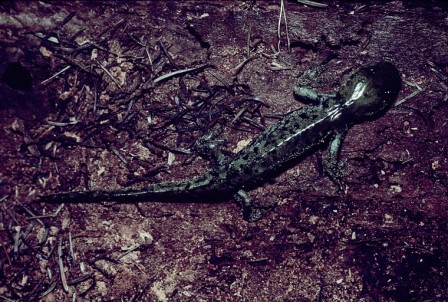
| General Description: | Tiger salamanders have smooth, somewhat slippery skin and a long tail. Each front foot has four toes. Maximum total length (TL) is about 13.6 inches (34.6 cm). The color pattern is highly variable, ranging from black with yellowish bars or spots to pale or dark with dark spots or mottling. Metamorphosed adults are stocky, have 11-14 vertical grooves on each side of the body, a broad head, small eyes, tubercles on the bottom of the feet. Mature male: large dark papillae posterior to bulbous vent during breeding season; tail relatively long. Larvae: hatchlings about 9-14 mm long, initially lack limbs; front limbs develop first, and hind limbs develop after larvae reach about 25 mm total length; large larvae (usually less than 13 cm TL but up to 35 cm TL) have three conspicuous pairs of gills and four gill slits on each side of neck; tail fin extends forward to about shoulder region; variable coloration. Eggs: laid singly or in short rows or small clusters; egg 2-4 mm in diameter, brown on upper surface, surrounded by jelly covering of thin dense inner coats and a thick soft outer coat, the whole unit being less than 10 mm in diameter; after laying, inner capsule surrounding egg liquefies, allowing egg to rotate. Source: Hammerson (1999). | ||||||||||
| Subspecies Comments: | The populations of Tiger Salamanders in British Columbia currently are considered to be A. t. melanostictum however it is likely that there will be divisions within the polytypic complex to yield a variety of species, based on ongoing systematic research (Schock 2001). | ||||||||||
| Identification Comments: | Adult Tiger Salamanders are large and heavy-bodied. A series of irregular dark bars span across their greenish to yellowish dorsal surface. The heads are large and the mouths have a large gape. The only sympatric salamander is the Long-toed Salamander (Ambystoma macrodactylum) which is considerably smaller, thinner and have a yellowish stripe running down their dorsal surface. The larvae of the two species can be difficult to distinguish when young, although toe length can be used. | ||||||||||
| Global Reproduction Comments: | In general, breeding occurs in spring in the north and at high elevations, in winter in the southern U.S., in late winter/spring and/or summer in the Southwest. Egg deposition may occur in early to mid-March in the Lower Columbia Basin (Leonard and Darda, 1995, Herpetological Review 26:29-30). In Arizona, within a single pond, opportunistic summer breeding may occur after the usual late winter/early spring breeding period (e.g., when dried ponds refill after summer rains) (Allison et al. 1994). Individual female deposit up to 1,000 eggs singly or in small clusters. Eggs hatch in about 2-5 weeks, depending on the temperature. Larvae metamorphose in their first or second summer, or they may not metamorphose at all (become sexually mature as gilled larvae). Breeding aggregations may include a few or up to several hundred adults. | ||||||||||
| Provincial Reproduction Comments: | Males typically arrive at breeding sites before females during early spring rains (Orchard 1991). It is suspected that not all females reproduce each year based on sex ratios at breeding sites. Breeding ensues after an elaborate courtship. Usually several hundred eggs are laid although up to 5000 eggs produced by a single female have been recorded. Eggs are laid singly or in small clusters attached to vegetation or debris. Adults usually leave the breeding site after egg deposition is completed. Incubation takes 2 to 3 weeks. Larval metamorphosis about two months or more, depending on environmental conditions. | ||||||||||
| Provincial Ecology Comments: | The distribution and availability of suitable breeding sites within 650 metres of suitable terrestrial habitats likely captures the distribution of the Tiger Salamander. A positive correlation between the abundance of pocket gopher burrows and Tiger Salamander distribution has been observed (Sarell 1996). Most Tiger Salamander burrows are thought to occur in open grasslands or shrub-steppe and possibly parkland forests. Little else is known about their ecology due to their aquatic and subterranean habits. | ||||||||||
| Migration Characteristics: (Global / Provincial) | |||||||||||
|
Nonmigrant: Local Migrant: Distant Migrant: Within Borders Migrant: |
N / N Y / Y N / N na / N |
||||||||||
| Global Migration Comments: | Most populations migrate seasonally up to several hundred meters between uplands and aquatic breeding sites. Timing of migrations and breeding is extremely variable throughout the range. | ||||||||||
| Provincial Mobility & Migration Comments: | Adult Tiger Salamanders migrate to breeding ponds from their terrestrial residences during spring and then return after breeding. Newly metamorphosed Tiger Salamanders migrate from the breeding ponds to upland terrestrial sites in mid to late summer after nightly rainfalls. A study on dispersal of California Tiger Salamanders (Ambystoma californiense) showed that most individuals did not travel further than 620m from breeding ponds with most adults residing closer to the ponds than subadults (Trenham and Shaffer 2005), however some Tiger Salamander individuals in BC have been found several kilometres from the nearest potential breeding site (Sarell 1996). | ||||||||||
| Habitats: (Type / Subtype / Dependence) |
|||||||||||
| Global Habitat Comments: | Tiger salamanders inhabit almost any terrestrial habitat as long as it includes the required aquatic breeding habitat, such as a lake, reservoir, permanent and ephemeral pond, or stream pool. They range from warm lowlands to high mountains and spend much of their lives in rodent burrows. | ||||||||||
| Provincial Habitat Comments: | Tiger Salamanders typically inhabit deep-soiled grasslands where they can utilize pocket gopher burrows to gain easy access to subterranean habitat where they spend most of the lives. Wood and rock are occaissionaly used as shelter objects, probably just for short periods of time. Breeding sites are variable and can be very alkali temporary pools or permanent lakes. Lakes with purple sulphur bacteria are never used. | ||||||||||
| Food Habits: |
Carnivore: Adult, Immature
Invertivore: Adult, Immature Planktivore:Immature |
||||||||||
| Global Food Habits Comments: | |||||||||||
| Provincial Food Habits Comments: | Larval Tiger Salamanders are visually oriented "sit-and wait" predators that primarily consume aquatic invertebrates such as odonate larvae and copepods, tadpoles and other salamander larvae (Schock 2001), while adults forage in water and on land consuming a large variety of invertebrates (e.g. worms, crickets) and will also eat other amphibians and neonate rodents. | ||||||||||
| Global Phenology: |
Circadian: Adult, Immature
Hibernates/aestivates: Adult, Immature |
||||||||||
| Global Phenology Comments: | As in most other land-dwelling amphibians, most terrestrial activity occurs during and after rains; freezing weather and drought inhibit activity. | ||||||||||
| Provincial Phenology: (1st half of month/ 2nd half of month) |
|||||||||||
| Provincial Phenology Comments: | Tiger Salamanders are probably dormant for the period in which frost is in the soil (mid November through February). Ground thaws probably elicit subterranean foraging until warm, nightly rainfalls in the spring permit migration to breeding sites. Reproduction is brief and most adults return to terrestrial sites. Eggs develop quickly and hatch. Larval development is accelerated by warm water temperatures and high iodine concentrations in the water. Cool, permanent waterbodies with low levels of iodine are capable of maintaining larvae until they reach sexual maturity (aka paedogenesis/neoteny). Otherwise metamorphosed young leave the breeding site during rainy nights, usually in July or August to terrestrial sites. Subterranean foraging probably occurs throughout the fall until the frost line penetrates the upper surface of the soil. | ||||||||||
| Colonial Breeder: | N | ||||||||||
| Length(cm)/width(cm)/Weight(g): | / / | ||||||||||
| Elevation (m) (min / max): |
Global:
Provincial: 275 / 1250 |
||||||||||
| Distribution | |||||||||||
| Endemic: | N | ||||||||||
| Global Range Comment: | Range extends from portions of southern Canada southward through much of the western United States and as far south as Puebla, Mexico. The ranges of A. mavortium and A. tigrinum meet in the Great Plains region, where their distributions meld. This species is absent from most of the Great Basin and most of the far western United States west of the Rocky Mountains. It has been introduced in many localities west of the Rocky Mountains. Elevational range extends to about 3,660 meters (12,000 feet). | ||||||||||
| Authors / Contributors | |||||||||||
| Global Information Author: | Hammerson, G. | ||||||||||
| Last Updated: | Jan 25, 2010 | ||||||||||
| Provincial Information Author: | Sarell, M.J. | ||||||||||
| Last Updated: | Feb 25, 2005 | ||||||||||
| References and Related Literature | |||||||||||
B.C. Ministry of Environment. 2005. Wildlife observation data for the Okanagan Shuswap Region. Ministry of Environment, Penticton, BC. |
|||||||||||
B.C. Ministry of Environment. Recovery Planning in BC. B.C. Minist. Environ. Victoria, BC. |
|||||||||||
British Columbia Ministry of Water, Land and Air Protection. 2004. Tiger Salamander in Accounts and measures for managing identified wildlife. British Columbia Ministry of Water, Land and Air Protection, Victoria, BC. 52pp. |
|||||||||||
Green, D.M., and R.W. Campbell. 1984. The Amphibians of British Columbia. Royal B.C. Mus. Handb. No. 45. 101pp. |
|||||||||||
Orchard, S.A. 1988. Species Notes for Amphibians. Vol. 4 in A.P. Harcombe, tech. ed. Wildlife Habitat Handbooks for the Southern Interior Ecoprovince. B.C. Minist. Environ., Lands and Parks, Wildl. Branch, Tech. Rep. R-18. 38pp. |
|||||||||||
Orchard, S.A. 1991. Provincial status report for the tiger salamander, Ambystoma tigrinum. Unpubl. rep., B.C. Environ., Wildl. Branch, Victoria. |
|||||||||||
Ovaska, K, S. Lennart, C Engelstoft, L. Matthias, E. Wind and J. MacGarvie. 2004. Best Management Practices for Amphibians and Reptiles in Urban and Rural Environments in British Columbia. Ministry of Water Land and Air Protection, Ecosystems Standards and Planning, Biodiversity Branch |
|||||||||||
Richardson, J.S., W. Klenner, and J. Shatford. 2000. The Tiger Salamander in British Columbia: An Amphibian in an Endangered Desert Environment. Pp. 407-411 in L.M. Darling, ed. 2000. Proc. Conf. on the Biology and Manage. Species and Habitats at Risk, Kamloops, B.C., 15-19 Feb.,1999. Vol. 1; B.C. Minist. Environ., Lands and Parks, Victoria, BC, and Univ. College of the Cariboo, Kamloops, BC. 490pp. |
|||||||||||
Sarell, M.J. 1995. Status of the tiger salamander (Ambystoma tigrinum) in British Columbia. Unpubl. rep. submitted to B.C. Environ., Wildl. Branch, Victoria. 18pp. |
|||||||||||
Sarell, M.J. 1996. Status of the Tiger Salamander (Ambystoma tigrinum) in British Columbia. Prepared for B.C. Minist. Environ., Lands and Parks, Victoria. 18pp. |
|||||||||||
Schock, D.M. 2001. COSEWIC status report on the tiger salamander, Ambystoma tigrinum, in Canada. Committee on the Status of Endangered Wildlife in Canada. Ottawa. 68pp. |
|||||||||||
Schock, D.M. 2001b. COSEWIC Status Report on the Tiger Salamander, Ambystoma tigrinum, in Canada. Interim Report, May 14, 2001. |
|||||||||||
Southern Interior Reptile and Amphibian Recovery Team. 2008. Recovery strategy for the Tiger Salamander (Ambystoma tigrinum), Southern Mountain Population in British Columbia. Prepared for the B.C. Ministry of Environment, Victoria, BC. 22 pp. |
|||||||||||
Trenham, P.C., and H.B. Shaffer. 2005. Amphibian upland habitat use and its consequences for population viability. Ecol. Appl..15(4):1158-1168. |
|||||||||||
Please visit the website Conservation Status Ranks for definitions of the data fields used in this summary report.
Suggested Citation:
B.C. Conservation Data Centre. 2010. Species Summary: Ambystoma mavortium. B.C. Minist. of Environment. Available: https://a100.gov.bc.ca/pub/eswp/ (accessed Oct 3, 2026).